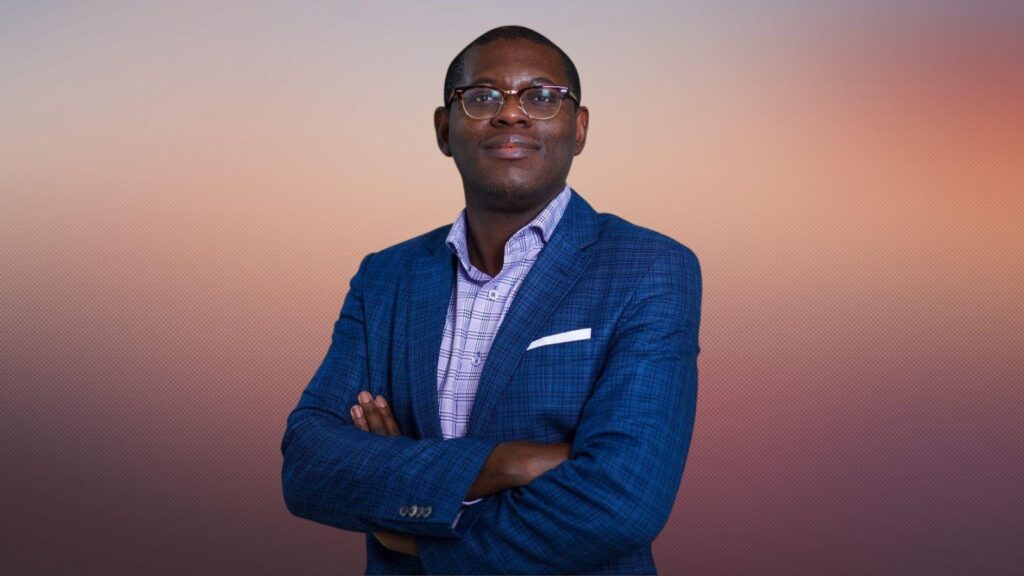
Bright Simons had just finished a TV appearance at a media studio in Accra. He had been dissecting Ghana’s GoldBod initiative, offering his succinct critique and backing his arguments with relevant data.
For more than an hour, he questioned the analytics behind some of their operations: How much gold were they buying? At what price? What alternatives had been considered?
The host listened intently, but Simons, most likely, knew listeners would filter his words through a partisan lens — pro-government or anti.
In a country where nearly everything is reduced to politics, his insistence on policy detail might often sound like noise to some. But to others, his analysis is a breath of fresh air and close to gospel.
Simons, 44, a social entrepreneur and honorary vice president of IMANI Africa, one of the continent’s most influential think tanks, has spent two decades trying to shift the conversation in Ghana and Africa.
His supporters call him one of the country’s sharpest minds. A writer from the media publication Financial Times once described him as “frighteningly clever“.
In his own words, he is not a politician, nor does he aspire to be one. Yet few public figures in Ghana provoke as much admiration and irritation as he does.
Political operatives often dismiss him, accusing him of working for the “other” side. Lately, his assertions and scrutiny during public appearances and on social media have led to defamation lawsuits from local industry players and companies.
At the heart of his work is a simple, stubborn conviction: Ghana has won its political freedom but has yet to master the harder art of governing effectively.
“I’ve stopped doing ideological politics,” Simons said in an online interview with The Labari Journal on the country’s political landscape.
“I don’t care what the grand ideological context is anymore. If you choose one path, think through it carefully, measure it as you move along, define your choices, explain, and back your choice with logical analysis. Be rational about it. That’s what I focus on now.”
Becoming a Policy Activist
Simons attended Presbyterian Boys’ Senior High School (PRESEC) in Legon, Ghana, where he served as President of the Student Representative Council.
He later studied Astrophysics on a research scholarship at Durham University in the UK.
It was during his school days that he began his work towards activism.
“I started activism in secondary school and then in Europe in the early 2000s on mostly migrants’ rights,” he said.
In his professional career, Simons invented the mPedigree/Goldkeys system. It allows consumers to verify product authenticity (initially medicines) via free SMS codes, helping protect millions from counterfeits across Africa, Asia, and beyond.

He returned to Ghana and joined IMANI in 2006, part of a small circle — including Franklin Cudjoe, Kofi Bentil, and others — that transformed the organization into a formidable policy watchdog.
According to Simons, when he came back to Ghana, the country’s policy landscape was still heavily shaped by Western consultants and international financial institutions.
Major initiatives, like the Single Spine Salary Structure, a unified public sector pay system designed to create equity and transparency by linking all public workers to a common salary scale, followed blueprints drafted abroad.
Then came the changes around 2010: the discovery of offshore oil, access to Eurobond markets, and a gold boom. Suddenly, Ghana had fiscal space.
It was around that period that governments began spending boldly — sometimes recklessly, according to Simons. Later on, scandals erupted over youth employment programs like GYEEDA and the Savannah Accelerated Development Authority (SADA).
Massive sums vanished or were unaccounted for with little documentation or evaluation. “We started to do policies where there was just no paperwork,” Simons recalled.
Political campaign promises became programs overnight, with scant analysis of costs, trade-offs, or alternatives.
“Policy was very ad hoc. Policy became completely marginal, and everything became politics. They [politicians] would go on campaign grounds and say certain things. And then when they elected, they will scramble to put everything together. There was no plan.”
In his view, a lot of Ghana’s politics and policies can be explained by a term he recently coined: “Katanomics”.
Explaining “Katanomics”
Ghana, Simons argues, remains trapped in what Kwame Nkrumah, Ghana’s famous leader, called “seeking the political kingdom.”
Independence was achieved through politics; post-independence struggles — from coups to the return of multiparty democracy — were political.
But the country never fully transitioned to the next stage: rigorous, evidence-based policy-making.

He calls this phenomenon “katanomics” — the systematic primacy of politics over policy, resulting in strong political accountability (voters know what they want) but weak policy accountability (few demand to know how it will be achieved).
“Everything in Ghana is existential politics. What kind of society do we want when it’s the only game in town? And my [katanomics] framework defines the problem there for us. How do we move to the how [of] this society?”
Simons says he’s baffled as to why there are still fierce debates on historical figures involving J.B Danquah and Kwame Nkrumah, as to who is the true “founder”.
He contrasts this with the United States, where intense founding-era debates are now historical curiosities. All the US founding fathers are revered, and the focus in the States has shifted to implementation and refinement.
“Why are we still fighting about J.B Danquah and Kwame Nkrumah? Because the country is still trapped in a stillbirth of politics. We are still defining the ‘what’.”
Growth of IMANI
IMANI’s prominence over the years has grown precisely because it filled a vacuum.
While older civil society groups focused on human rights and democratic consolidation — vital work in earlier decades — the new challenges were technical: opaque loans, inflated contracts, poorly designed social programs.
Simons and his colleagues campaigned against the controversial STX housing deal and a $3 billion loan from the China Development Bank. They demanded feasibility studies, cost-benefit analyses, and monitoring frameworks.
Over time, IMANI’s work has been critical. Politicians in power often accuse the firm of “sabotage” and colluding with political rivals.
But IMANI has become a household name in Ghana, often receiving invites from media houses for TV and radio appearances to break down policies and critique the government.
Despite the work done, Simons says the habit of careful policy design has never fully taken root.
“I think they (middle class elites) are useless and dysfunctional. They don’t behave like the middle class anywhere else in the world.“
But one section of the population, which Simons expected more from in scrutinising government policy, is Ghana’s middle class.
Disappointment in Ghana’s (Elite) Middle Class
Simons reserves particular scorn for the country’s middle class, especially those in elite circles. In most societies, he says, the professional class — lawyers, bankers, consultants — forms the backbone of policy discourse.
They are up to date with the news, constantly reading reports, debating trade-offs, and holding officials to account.
In his view, Ghana’s middle class has failed to hold its end of the bargain. Simons finds them too disengaged, preferring gossip and partisan point-scoring.
“I think they (middle class elites) are useless and dysfunctional”, he says. “They don’t behave like the middle class anywhere else in the world.“
He makes a distinction in his criticism, separating the “well-to-do” from the average middle class.
“A lot of ordinary people have to rely on their brawn. They have to get up [early], go and hustle in Makola. You can’t expect those people to come sit down and analyze [policy issues like the gold purchase program],” he said.
But for those who are in more comfortable spaces? Simons doesn’t hide his disdain.
“You have an office, air-conditioned office, you are sitting in air conditioning, you are wearing tie and coat. You can’t sit there and read, spend 30 minutes reading something and then type on social media a few issues that you’ve highlighted. You can’t even do it. What kind of a middle class is that?“
Battling Defamation Lawsuits
In his crusade for public accountability, Simons has fallen on the bad side of some individuals and firms in the country for his outspoken criticism.
In 2025, he was served with multiple defamation lawsuits for utterances on TV, radio, and social media.
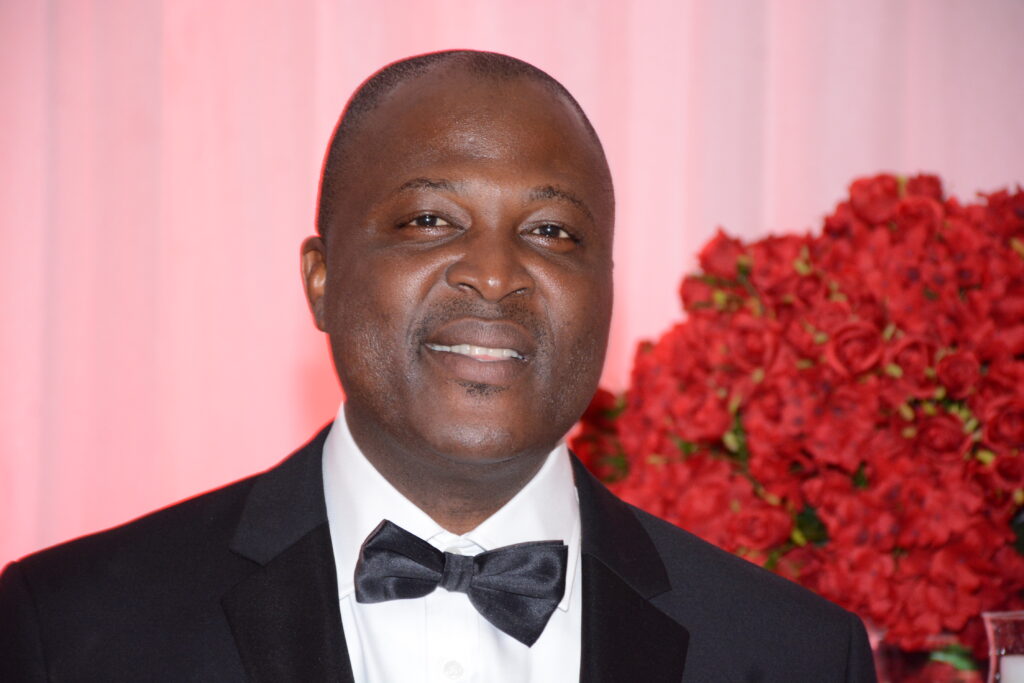
Businessman Ibrahim Mahama, brother of President John Mahama, and his company, Engineers & Planners, sought millions in damages over Simons’s comments linking a mining contract to potential conflicts of interest.
Another suit arose from Simon’s criticism of a company he alleged was inserted into a government deal without proper authorization.
Simons views these cases as symptoms of the same problem: in a society where policy is privatized and intertwined with private gain, public scrutiny feels like a personal attack.
“Every policy is linked to some procurement or some other benefit that is of a private nature,” he said. “And I do public policy analysis with an activist lens. So literally I’m treading on people’s business.”
In November 2025, a court dismissed Simon’s application to strike out the lawsuit from Mr. Mahama.
The defamation case remains pending before the High Court in Accra.
Trying to Build Future Activists
Despite the toll of legal fees and public vilification, Simons shows no sign of retreating.
He continues to appear on radio and television, posts long X threads unpacking budget lines and contract clauses, and mentors younger analysts.
However, trying to build up more activists to continue the work they do at IMANI has proved to be a challenge.
He notes that professionalizing policy activism is difficult; talented researchers often drift to higher-paying jobs in consulting or the private sector. Building a broader movement focused on policy rather than mass political mobilization has proven elusive.
“Some people we brought on realized that the work that we are doing is the same that you do in the private sector analysis space, like in consulting or auditing,” Simons stated.
“They are quite skilled, and they would leave and work for the private sector. So now we are in a bit of a quandary.”
Simons stated that Civil Society Organisations (CSOs) like IMANI would need to pay market rates to retain top analysts, but those analysts are not necessarily committed activists.
He believes Ghana needs a separate activist movement distinct from the CSO establishment.
“I’m beginning to think that the idea of activists working inside CSO organizations is ad hoc… we need a separate activist movement. I just don’t know how we do movement building.”
Currently, Simons is focused on his “katanomics” framework and trying to bring more visibility to government policies.
He hopes that more outlets like The Labari Journal and High Street Society would create new frameworks to get more activists in policy, not just in politics.
His work is not done yet, but his hope for Ghana’s middle class keeps dwindling.
“Whenever I have talked about just leaving the space, it’s been because I think the middle class is hopeless.“
Correction: We updated the article to reflect that Mr. Simons studied Astrophysics on a research scholarship and not for a degree from Durham University. The error has been corrected.