



JOHANNESBURG — For over a decade, the pitch was as consistent as it was ambitious: Africa didn’t need a Silicon Valley import to tell its stories. It needed Showmax.
But on Thursday 5th March, MultiChoice Group—the continent’s pay-TV titan—announced it would pull the plug on its homegrown streaming darling.
The decision marks the end of an 11-year odyssey that saw the company spend billions of rands in a high-stakes poker game against global giants like Netflix and Disney+, only to be folded by its new French owners, Canal+.
A Grand Vision
Launched in 2015, Showmax was born from a defensive necessity. As broadband speeds crept up across Lagos, Nairobi, and Johannesburg, MultiChoice’s lucrative DStv satellite business faced an existential threat.
In May 2016, Multichoice expanded the service, rolling Showmax out to 36 African countries.
Showmax was the countermove—a “hyper-local” platform that combined HBO blockbusters with original African dramas and, crucially, the English Premier League on mobile devices.
The strategy was sound on paper: win the hearts of Africans with local content while offering payment methods like M-Pesa.
Tali’s Wedding Diary, Showmax’s first original series, sets a record for first-day views. Multichoice would later introduce Showmax Mobile, a lower-cost, mobile-only subscription in October 2019.

In July 2020, Showmax Pro was launched and included content such as Premier League, Serie A, La Liga, and PSL games, and live sport events including IAAF athletics with the standard entertainment catalog.
The Pro package was later axed in 2022.
Showmax hit a significant milestone in 2022 when it overtook Netflix in subscriber numbers in Africa, holding roughly 40% of the market share.

The $177 Million Hail Mary
The beginning of the end arguably started with a massive gamble in early 2024. In a desperate bid to scale, MultiChoice partnered with Comcast’s NBCUniversal, migrating Showmax onto the technical architecture of the American streamer Peacock.
The “Showmax 2.0” relaunch was a spectacle of corporate spending. MultiChoice and NBCUniversal injected roughly $309 million in equity funding to retool the platform.
In the last year alone, losses for the streaming division ballooned by 88%, hitting R4.9 billion ($260 million).
While subscriber numbers grew by 44% following the relaunch, the “maths of streaming” remained brutal.
High data costs for users and a fragmented regulatory landscape meant that for every rand Showmax earned, it seemed to be spending two on server costs and star-studded “Originals.”
The Canal+ Factor
The final blow came not from the market, but from the boardroom. Following the R35 billion ($2 billion) acquisition of MultiChoice by the French media powerhouse Canal+ last year, a “comprehensive review” was initiated.
Canal+ CEO Maxime Saada had already signaled his skepticism during investor calls, bluntly describing the platform as “not a commercial success.”

For the French conglomerate, maintaining a bespoke African streaming service was a luxury they could no longer afford as they sought €400 million in group-wide cost savings.
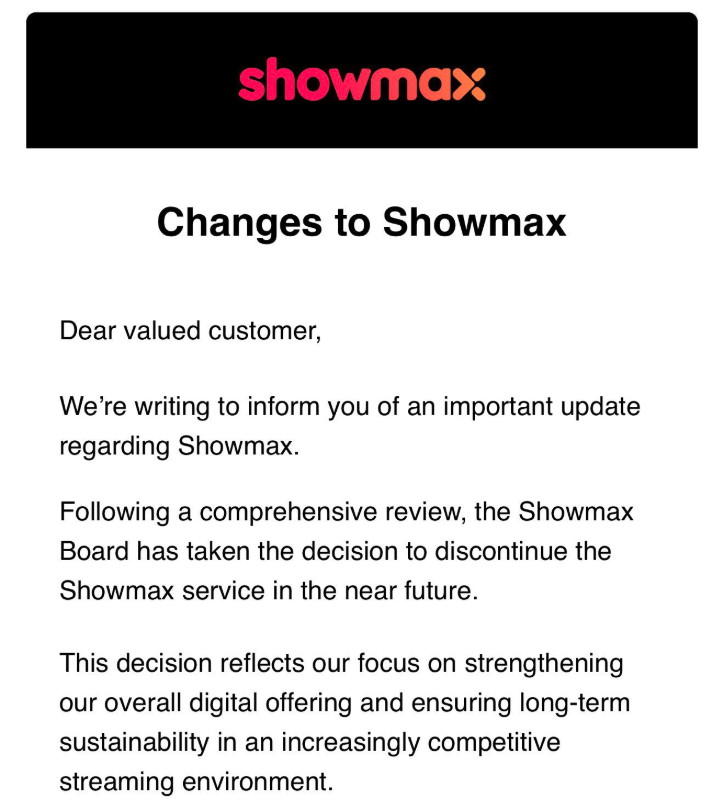
“The decision to phase out Showmax reflects our focus on building a sustainable, competitive business for the long term in an increasingly demanding global streaming environment,” the company said.
On Thursday, March 5th, Showmax received emails stating that the service would shutting down.
What Remains
For the thousands of actors, directors, and crew members who turned Showmax into a cultural powerhouse—producing hits like The Real Housewives of Durban and Adulting—the news is a dark day in the local content industry.
While MultiChoice insists that “streaming remains central” and that staff will be reassigned rather than retrenched, the era of the independent African streaming insurgent looks to be over.
The library of local content is expected to be folded into DStv’s linear channels and a new, unified Canal+ app, effectively turning Africa’s “Netflix” into a digital wing of a European legacy broadcaster.
This article was edited with AI and reviewed by human editors



Follow