


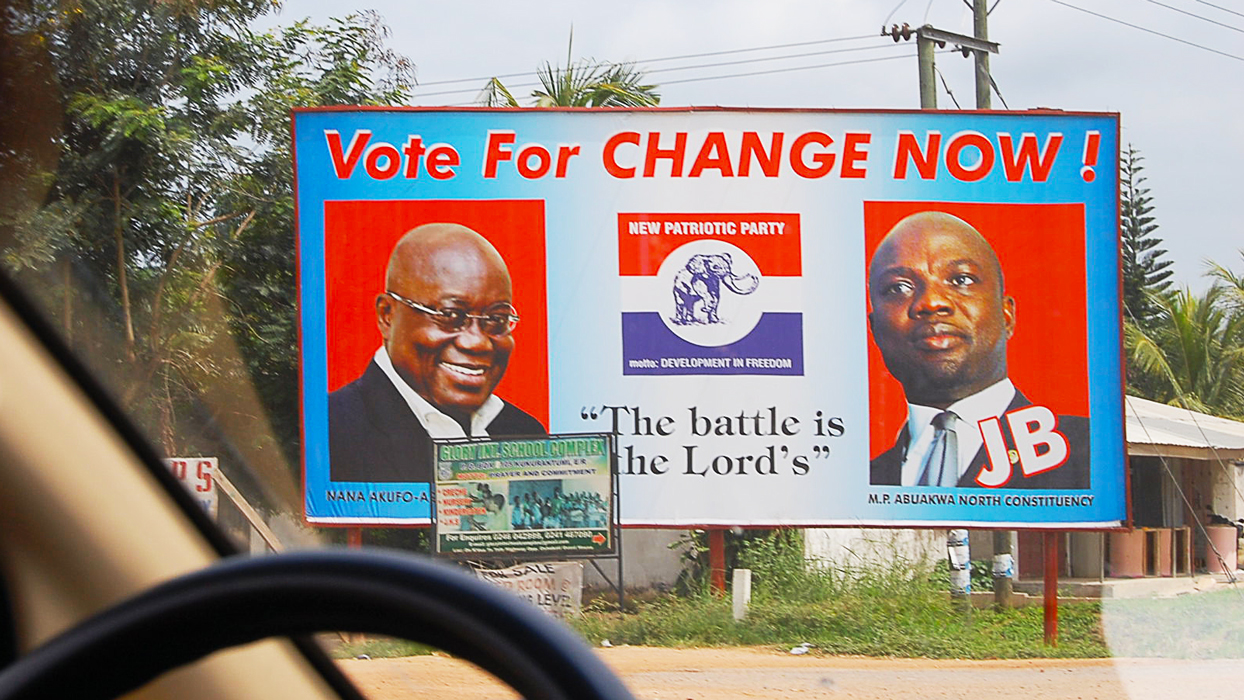
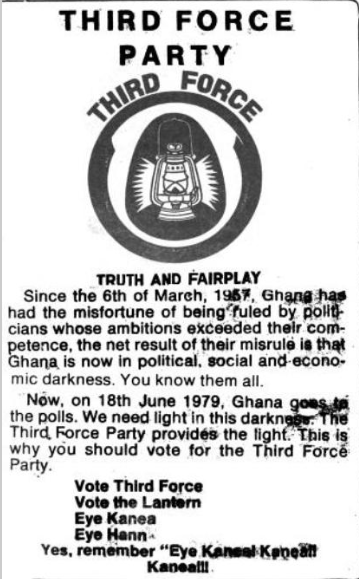
The advertisement was blunt in the way that only a certain kind of political desperation can be.
Published ahead of Ghana’s June 18, 1979, general election, a political party known as the Third Force Party distributed campaign flyers that opened not with a promise but with an indictment.
“Since the 6th of March, 1957,” it reads, “Ghana has had the misfortune of being ruled by politicians whose ambitions exceeded their competence.”
The party’s remedy was a lantern — its symbol, its rallying cry, its entire argument. Vote the Lantern. Eye Kanea. Eye Hann. We need light in this darkness.
It was, for its time, a remarkable piece of political theatre. And it was also, as history would record, a spectacular failure.
The Third Force Party’s presidential candidate, John Bilson, won just 2.8% of the vote in the 1979 election.
The presidency went to Hilla Limann of the People’s National Party, who secured 62% in a runoff.
Two years later, Jerry Rawlings’ military coup extinguished all party politics entirely.
Proposal for an Alternate Government
In some circles, the 1979 flyer resonated in Ghana’s political landscape.
Ghana was emerging from a bruising cycle of military governments that had interrupted its post-independence democratic experiments.
The Supreme Military Council had just been overthrown by Rawlings in a junior officers’ uprising in June 1979 — barely weeks before the election itself.
The Third Force Party positioned itself as neither Nkrumahist nor Busia-Danquah — the two great ideological traditions that had dominated Ghanaian politics since the founding of the state.
It spoke instead to a simpler, more visceral frustration: that the men who had governed Ghana, whatever their ideology, had made a mess of it.
The flyer’s reference to March 6, 1957 — Ghana’s independence day — was pointed. Two decades of self-rule had produced not prosperity, but a country stumbling through coups, economic mismanagement, and political upheaval.
The Third Force Party was not merely proposing an alternative government. It was putting the entire post-colonial political class on trial.
Years Later, Barely a Change
Fast forward 45 years, and the language has barely shifted.
“Ghana, our motherland, is at a crossroads,” said Dr. Kenneth Ofosu-Barko, a Ghanaian medical professional and political activist of the Roundtable Dialogue think-tank in July 2024.
Mr Ofosu-Barko would announce yet another coalition effort to break the dominance of Ghana’s two ruling parties.
“A country that 67 years ago was the shining star of Africa and showed great promise has been reduced to a land of hewers of wood and drawers of water due to poor administration.”
He could have been reading from the Third Force Party’s 1979 flyer.
Today’s version of that lantern-holding tradition is a crowded, fractious field.
The Movement for Change (M4C), led by former trade minister Alan Kyerematen, broke away from the NPP ahead of the 2024 elections, forming the Alliance for Revolutionary Change (ARC) — a coalition of smaller parties and movements aimed squarely at the NPP-NDC duopoly.
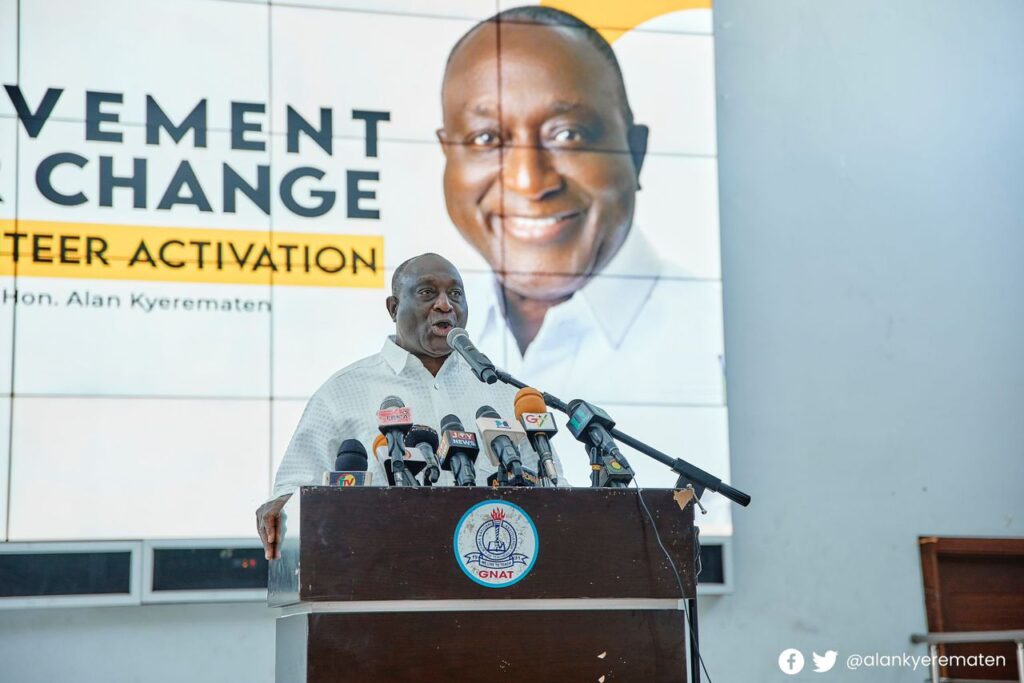
A newer entrant, UP Plus, received its official registration from the Electoral Commission in October 2025, billing itself as a vehicle to “depose the duopoly that has led this country into its worst ebb.“
The economic backdrop, much like 1979, provided the urgency: Ghana went through an economic crisis severe enough to require an IMF bailout, with record unemployment, soaring food prices, and widespread public anger.
The incumbent NPP, under Vice President Mahamudu Bawumia, lost heavily to the NDC’s John Mahama in the December 2024 polls. The power was returned to the NDC, affirming Ghana’s political landscape as a two-horse race.
The Geometry of the Duopoly
What makes Ghana’s third-force problem so stubborn is structural, not merely sentimental.
Since the return to constitutional rule in 1992, the NPP and NDC have built an extraordinary machine of political dominance. In 1992, smaller parties and independent candidates combined for 11.3% of presidential votes.
By 2020, that figure had collapsed to just 0.8%. The number of third-party and independent MPs fell from 11 in 1992 to zero by 2016.

Kyerematen, despite being arguably the most credible outsider challenger in Ghana’s democratic history — polls once showed 54% of Ghanaians preferred him to lead the NPP into 2024 — won just 0.26% of the presidential vote running independently.
Nana Kwame Bediako, another prominent independent, secured 0.73%.
The reasons are structural. Ghana’s 1992 Constitution requires the president to appoint a majority of ministers from Parliament, making parliamentary representation existential for any party aspiring to govern.
The two dominant parties have also mastered the art of co-optation — absorbing promising third-force figures with ministerial appointments or political patronage before they can consolidate a rival base.
There is also the psychology of the wasted vote.
In a country where elections have been decided by razor-thin margins, many Ghanaians have concluded that voting outside the NPP or NDC is an indulgence they cannot afford.
Can A “Third Force” Eventually Emerge?
The Third Force Party of 1979 never won a parliamentary seat, never formed a government, and was erased within two years by a military coup.
It is a footnote in Ghana’s electoral history.
Ghana’s third-force movements have always known how to speak the language of national disappointment. What they have consistently failed to do is translate that language into votes, seats, and ultimately, power.
Data from surveys show that the years between 2002 and 2012 witnessed a period of strong demand for more political parties, growing by as much as 24 percentage points.
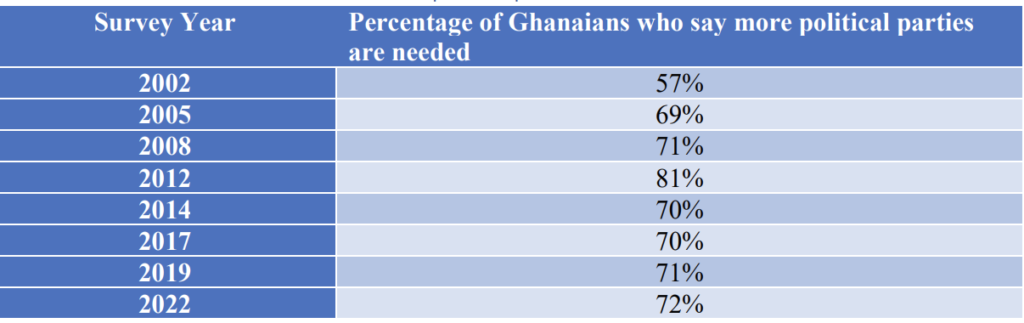
Although the demand still remains high, it decreased by nine percentage points between 2012 and 2022. This suggests Ghanaians broadly want more options, but that enthusiasm has somewhat cooled as the NPP-NDC grip has tightened.
Whether UP Plus, the remnants of the M4C, or some future movement yet unnamed can do what John Bilson’s lantern could not remains Ghana’s most persistent political question.
This article was edited with AI and reviewed by human editors



Follow