Story Highlights
- A six-member committee has concluded that 29-year-old engineer Charles Amissah, turned away by three Accra hospitals, died from blood loss — not accident injuries
- The committee found that basic interventions at any of the three facilities could have saved his life
- Four healthcare workers have been interdicted, with more under investigation
- Ghana has had an emergency care policy since 2011; the Amissah case is evidence that it has never been consistently enforced
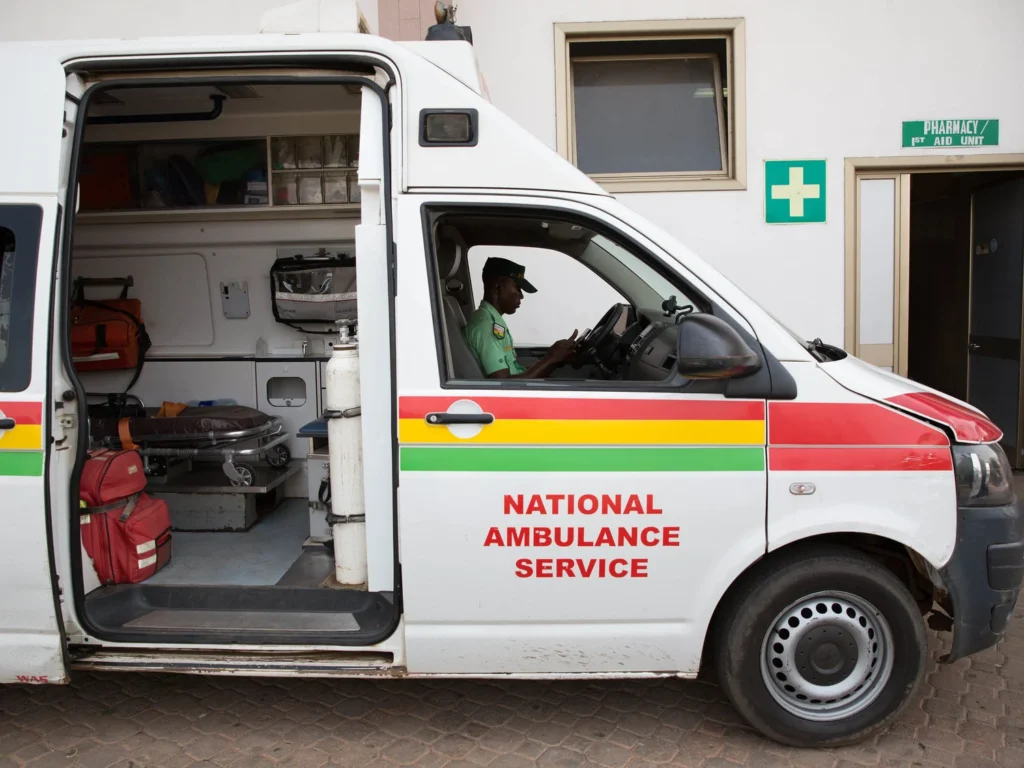
Shortly after 10:30 p.m. on February 6, 2026, emergency responders arrived at the Kwame Nkrumah Circle Overpass in Accra, where 29-year-old engineer Charles Amissah lay bleeding after a hit-and-run incident.
According to the National Ambulance Service, Emergency Medical Technicians arrived at the scene within three minutes and found Amissah with profuse bleeding from a deep shoulder laceration. He was alive.
What followed was a two-hour ordeal that ended in his death — not from the injuries themselves, but from the response to them.
The ambulance’s first stop was the Police Hospital at 22:43 hours, where the patient was not attended to and was referred onward after just 11 minutes.
He arrived at the Greater Accra Regional Hospital at 22:58 hours but was again turned away.
By 23:20 hours, the ambulance reached Korle Bu Teaching Hospital, where no emergency intervention was initiated.
Amissah was pronounced dead at 00:30 hours — approximately 118 minutes after the incident — while still in the ambulance.
A Committee’s Verdict
An independent investigation found that Amissah died not from the initial trauma but from prolonged, preventable blood loss — exsanguination — due to failure of emergency medical care.
The report stated that he was alive at every stage of the ordeal, from the accident scene to the Police Hospital, the Greater Accra Regional Hospital, and Korle Bu Teaching Hospital, yet none of these facilities provided timely life-saving intervention such as bleeding control, IV fluids, or blood transfusion.

Professor Badu Akosa, the committee chairman, emphasised that basic interventions — applying pressure to control bleeding, wound packing, and administering intravenous fluids — could have stabilised the patient.
“If at any of these facilities there had been medical intervention, Charles Amissah could have survived,” he stated.
The committee was formed by Health Minister Kwabena Mintah Akandoh on February 23, 2026, and its report was submitted on May 6. Its six members included senior emergency medicine specialists and retired health officials.
The panel’s verdict was unambiguous: the death was avoidable.
Who Is Being Held Responsible
Among those cited is Dr. Anne-Marie Kudowor, who has been recommended for referral to the Medical and Dental Council for disciplinary action, having allegedly failed to exercise professional judgment and provided “untruthful” information during the investigation.
The report does not specify what information she provided.
The other doctors named include Dr. Nina Naomi Eyram of Ridge Hospital, Dr. Ida Druant, and Dr. Genevieve Adjar of Korle Bu, alongside three nurses.
Korle Bu has since interdicted two doctors and two nurses.
A Familiar Story
The disciplinary recommendations against specific clinicians are individually defensible.
But social commentators have raised an uncomfortable question: can the conduct of a handful of healthcare workers fully explain a failure that played out identically across three separate institutions in a single night?
The report fails to single out institutional leadership. The Medical Directors and CEOs of the Police Hospital, GARH, and KBTH face no named accountability. If three hospitals in sequence failed the same patient, that points to a governance failure above the frontline staff level.
The response has been familiar: public anger, media discourse, official statements.
President John Mahama weighed in, emphasising that no patient should be turned away.
And yet, this is not the first time. The cycle has become predictable — tragedy, outrage, blame, directives, and then silence.
Ghana’s “Policy and Guidelines for Hospital Accident and Emergency Services in Ghana,” a 33-page document signed by over 40 medical experts, was designed precisely to prevent this.
It mandates a triage system and clearly states that patients classified as critical shall be admitted for further management. The policy has been in effect since 2011.
On the night Charles Amissah was turned away, it was ignored at each of the three facilities he was taken to.
Academic research has long characterised the “no bed syndrome” not as an absence of physical beds but as a symptom of a poorly functioning emergency health care system — one driven by a complex of factors including health system priorities and values.
Solutions attempted to date have been fragmented rather than well-coordinated whole-system reform.
In 2026, with digital systems, mobile technology, and health information platforms available, hospitals within the same city are still failing to coordinate bed availability. Emergency services are operating without a centralised, real-time referral system.
A Pattern of Promises
The minister’s assurances in the wake of the committee report echo statements made after every previous iteration of this crisis.
At a Government Accountability Series event in April, Minister Akandoh said the committee’s findings would be made public soon, adding: “We will not hesitate — I know some people will not be happy — but we will not hesitate to implement the recommendations to the letter.“
In the weeks following Amissah’s death, Akandoh also announced plans to seek parliamentary legislation on emergency health response, add beds to existing facilities, and establish a dedicated emergency facility near Burma Camp.

Professional bodies, including the Ghana Medical Association, also identified poor coordination, ageing ambulance fleets, and limited funding as key contributors. These are not new diagnoses.
The report’s recommendations are all worthwhile but lack assigned responsible parties, deadlines, or implementation mechanisms.
What Actual Reform Would Look Like
The committee has recommended integrating the Ghana Armed Forces Critical Care and Emergency Hospital — a 150-bed facility with an ICU — into the national emergency care framework, and establishing a National Emergency Care Fund to cover the first 24 hours of treatment in both public and private facilities.
But structure requires political will to build and sustain. Health experts have noted that the Ministry of Health was responsive in the immediate aftermath, engaging with facilities and providing additional beds to ease congestion — but these remain short-term fixes that do not address underlying systemic weaknesses.
Increasing beds alone is insufficient without improving patient flow and operational efficiency.
The committee’s report on Charles Amissah’s death is thorough, credible, and sober in its conclusions. The harder question is not what it says, but whether it will be read differently from all the reports that came before it.
This article was edited with AI and reviewed by human editors