
In 2019, former President Nana Akufo-Addo launched an e-justice system as part of a $97 million e-Transform project. The project was a paperless court system designed to enhance Ghana’s efforts in improving its justice delivery.
Funded by the World Bank, the project would automate the existing manual filing systems within the court registries, from the filing of cases to the execution of court decisions.
“The project is attempting to help ensure that the law keeps pace with technology, ending the age-old ‘missing dockets’ phenomenon and endless litigations, which have plagued the efficient delivery of justice in the country for several years,” the President stated at the launch event.
The plan was to roll out the e-Justice project to the Supreme Court, the Court of Appeal, all High and Circuit Courts in the regional capitals, as well as the Tema Metropolitan area by 2022.
But fast forward to 2025, the platform appears to have suffered setbacks due to delays and technical challenges, slowing down implementation in the court systems.
According to a recent International Monetary Fund (IMF) governance report, it would appear that the project has “stalled“.
Failure to Launch?
After its initial launch, several reports indicated that the system was “unusable” due to unreliable internet service, which prevented users from accessing the system for cases and filings.

Information on the use of the platform is scarce. However, in a document produced by the Judicial Service of Ghana in 2022, the number of cases on the system was 61,000+ as of 2022. This is an increase from 58,495 compared to the previous year.
According to the same document, the system’s scope for a pilot was changed to 2022 and will be ready in 2026, despite “launching” in 2018.
In an expression of interest sent out in 2022, the project sought a consultant for implementing a change management system.
Some lawyers that The Labari Journal spoke to stated that they do not use the eJustice platform due to technical challenges, resorting to the manual process.
We emailed the Ministry of Justice for comment on this story. We did not receive a response at the time of this publication.
IMF Governance Report
A 2024 report by the IMF observed that the eJustice platform’s lack of critical resources and technical reliability is stalling the digital transformation of the courts.
These gaps have led to inefficiency, heavy workloads, and concerns over the accuracy of judicial records.
Publishers of the report state that while some courtrooms proudly bear the designation of “automated,” efforts to digitize the judiciary have, for the most part, “predominantly failed due to a consistent lack of funding”.
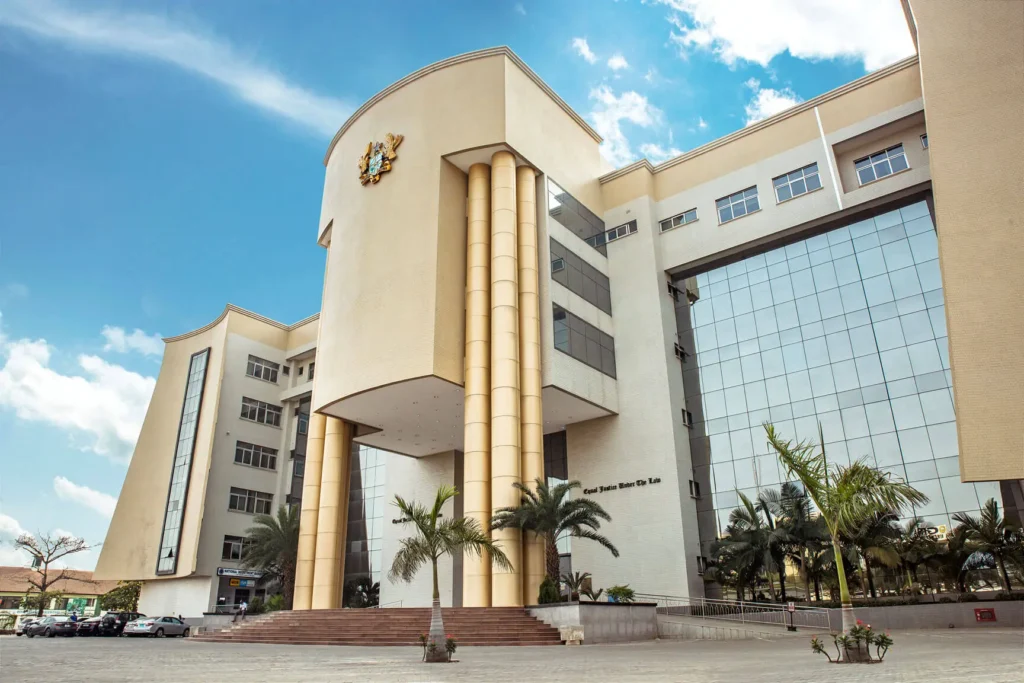
It was noted in some courts, manual processes were being utilised, with court proceedings being dictated in physical notebooks.
The report further stated that the technology itself has proven to be a stumbling block, with digital audio recordings being “unreliable“.
Inconsistencies and Work Overload
Without a digital system in place, judges are currently overburdened with heavy workloads.
The IMF reported that judges may be required to handle as many as 35 cases on certain days, a caseload that inevitably strains their capacity for detailed attention and efficient administration.

It noted an example where a judge issued a written order that was different from what had been read in open court.
Without automated processes and reliable record keeping, such discrepancies could continue.
Financial Independence
Currently, the judiciary is only permitted to retain 30 percent of its internally generated funds.
The report stated that allowing the judiciary to retain a greater share of these funds is seen as the critical step needed to provide the dedicated and consistent financing necessary to overcome the current technical and logistical hurdles.
It concluded that without this financial independence, the dream of a truly modern, efficient, and transparent e-justice system will likely remain deferred.