On November 18th, Wendell Nana Yaw Yeboah, the Head of Mobilisation at Democracy Hub, a civil society group in Ghana, appeared on the Aluta FM radio station for an interview.
In his interview, he alleged that three Regional Ministers were complicit in galamsey (illegal mining) operations in their regions. Those ministers were Rita Akosua Awatey (Eastern Regional Minister), Dr. Frank Amoakohene (Ashanti Regional Minister), and Joseph Nelson (Western Regional Minister).
According to reports, the three ministers filed a petition to the Criminal Investigation Department (CID), claiming that Mr Yeboah’s comments bordered on “defamation” of their character.
Mr. Yeboah was subsequently arrested on November 26, 2025.
Allegations of Bail Interference
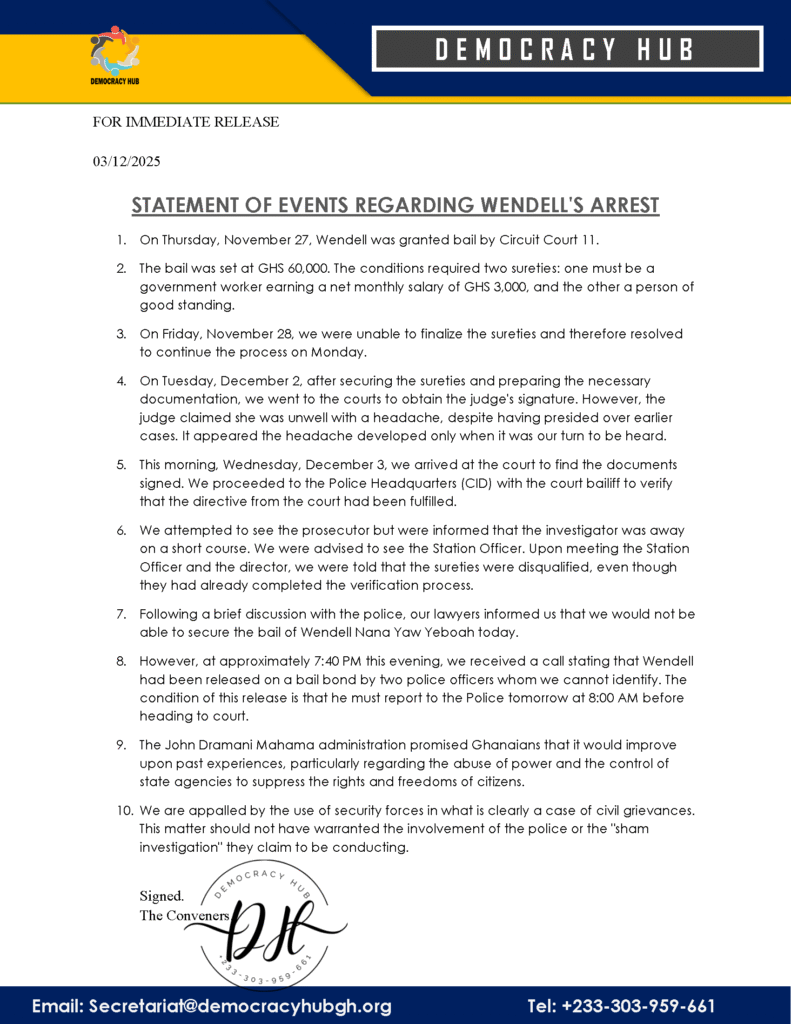
Democracy Hub sought to bail out Mr. Yeboah but faced challenges and peculiar irregularities. The group claimed that they also faced undue interference by police authorities.
The group stated that Mr. Yeboah was granted bail by Circuit Court 11 on Thursday (27 November), set at GHC60,000 with two sureties—one being a government worker earning at least GHC 3,000 per month, and the other a person of good standing.
Democracy Hub claims that they secured the sureties, but on Tuesday (2nd December), a judge refused to sign the necessary documentation, citing illness, despite presiding over earlier cases that day.
In a press release, the group narrated how they finalised their documents, but police officials disqualified the sureties despite their prior verification, preventing Mr. Yeboah’s release.
However, the group was later informed on Wednesday evening that Mr. Yeboah had been released on bail by two police officers whom they could not identify.
The Legal Ramifications
Mr. Yeboah’s commentary rapidly escalated from political controversy to a legal confrontation.
From some reports, the petition filed by the Ministers accuses him of criminal defamation and publication of false news. These charges carry serious penalties under Ghanaian law.
However, these laws have often been criticized by human rights groups for being overly broad and used to stifle press freedom.
His detention, critics argue, sends a bad message to the country’s journalists and civil society.
While the government maintains that no one is above the law and that the ministers have a right to defend their reputation, the speed and severity of the response to Mr. Yeboah’s suggestions have raised alarms.
The Galamsey Controversy
Illegal mining has become an existential threat to Ghana, famously leading to the contamination of major water bodies like the Pra, Ankobra, and Tano rivers.
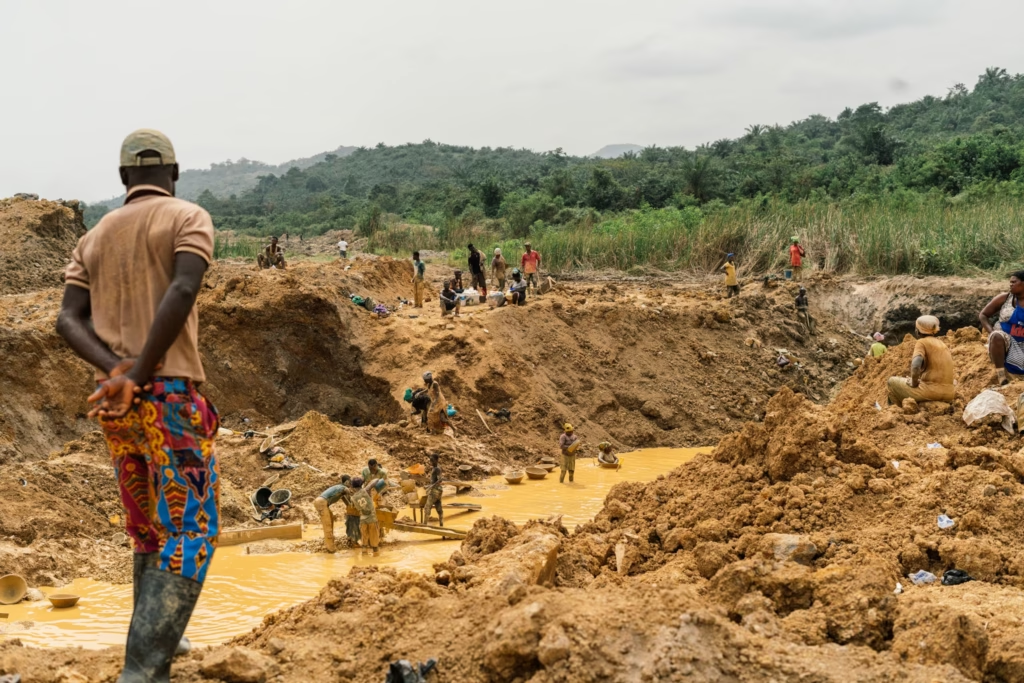
The use of heavy machinery and toxic chemicals, particularly mercury and cyanide, has rendered vast tracts of land infertile and polluted the water source for millions.
Successive governments have launched initiatives to combat the menace, including military-led operations like “Operation Halt.”
Yet, observers consistently point out that the illegal operations often resume the moment the task forces depart, suggesting a deep-rooted system of political patronage or corruption that shields the financiers of the operations.