
For a generation of young Ghanaians, the path to a career once required a suit, a mahogany desk, and the patient climbing of a corporate ladder.
But thanks to digital tools like social media and the internet, there has been a powerful shift.
The new workplace is increasingly a personal room, a small studio, or a borrowed smartphone, where a relentless wave of creative entrepreneurs is transforming content creation from a hobby into a foundational pillar of the digital economy.
This emerging “creator economy” is doing more than just entertaining; it is reshaping how brands communicate, influencing purchasing decisions, and building digital communities that rival traditional media in reach and relevance.
In Ghana, the movement is defined by a specific kind of grit—a “start with what you have” ethos that is turning resourcefulness into a new form of currency.
Creating With What You Have
The evolution of Perry Tintin, a tech reviewer, serves as a blueprint for this professionalization.
Like many young Ghanaians, Perry did not begin his creative journey with a full studio or a strategic roadmap. He started with curiosity.
Before he became known for clean tech reviews and polished visuals, he was simply a travel vlogger trying to fit creativity into the gaps left by corporate work.
But the demands of travel content made consistency nearly impossible. That challenge forced a rethink, and that rethink led Perry into the tech content niche, a space more aligned with his lifestyle and strengths.
What followed was a turning point that steadily positioned him within Ghana’s fast-growing creator space.
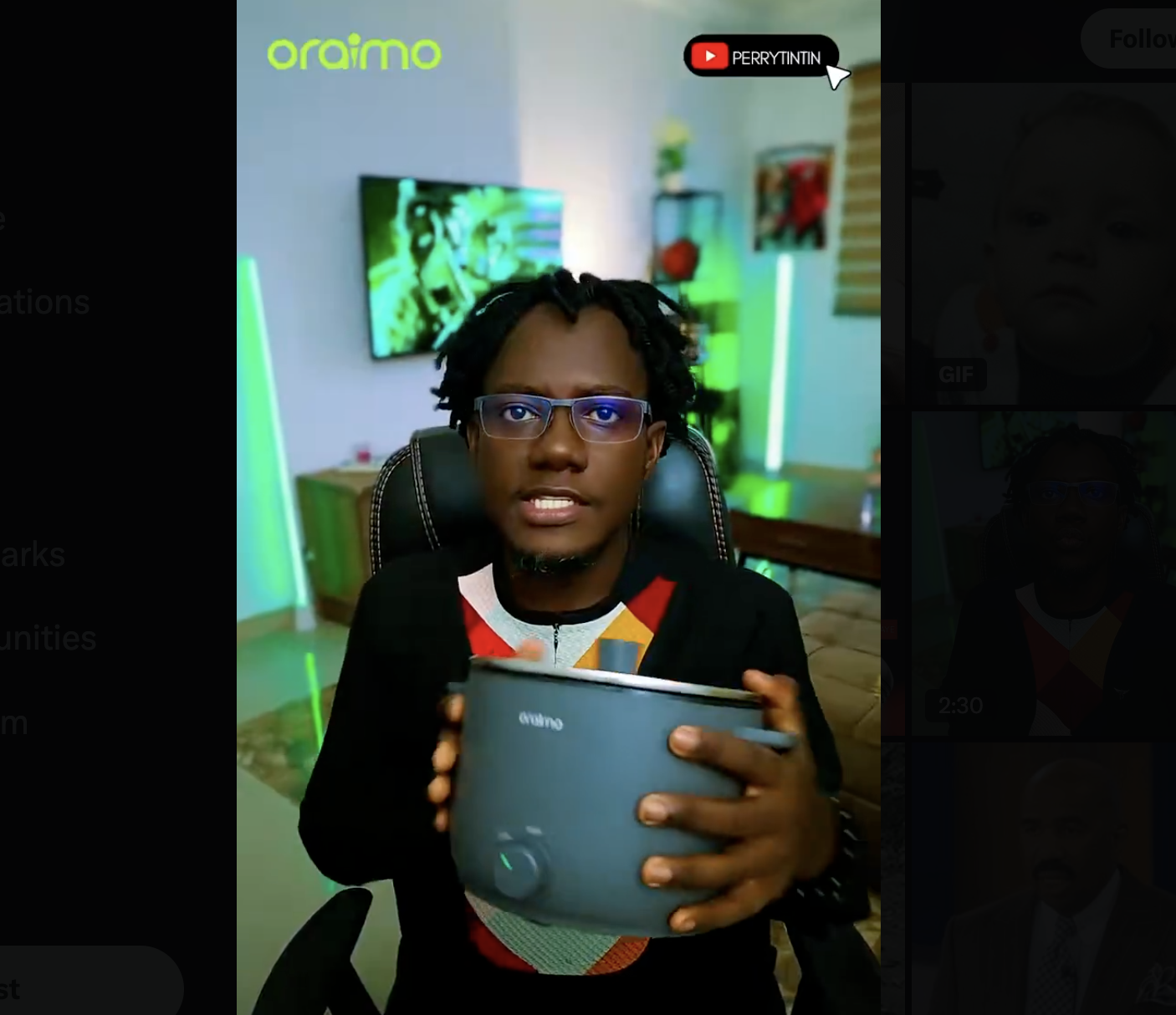
With no dedicated microphones or lighting, Mr. Tintin’s production schedule was dictated by the sun. Every video was recorded and edited on a 128GB iPhone 12, a process plagued by constant battles with storage limits.
“I wish I had started earlier,” Mr. Tintin reflected. “I was waiting for equipment I already had”.
Today, that patience has yielded a two-bedroom apartment with a dedicated studio and over GHC 60,000 worth of gear.
His trajectory from window-lit sessions to polished tech reviews—while still balancing a corporate job—underscores the slow, steady consistency required to thrive in this space.
From Borrowed Phones to Global Paychecks
While Mr. Tintin found success through a strategic pivot from travel vlogging to tech, others like Clifford Scott began their journey while still in Junior High School.
He spent hours consuming tech content online during his early teens, educating himself. Over time, he had so much information at his fingertips that he felt compelled to share it with others, especially Ghanaians who often found technology too complex or too foreign.
Lacking even a phone of his own, Mr. Scott borrowed his mother’s device to record tech explainer videos.
“I used to save the small money given to me for upkeep at school just to buy data so I could upload my videos on weekends,” Mr. Scott said.
His first YouTube upload garnered 5,000 views in days, signaling a massive local demand for accessible technology education.

In less than a year, Clifford reached the YouTube Partner threshold and got monetized, an achievement some creators chase for three to five years.
That milestone became more than just a badge; it was validation. With his first earnings, he bought his first content-creation phone, which was a Samsung S23, and decided he was never looking back.
Today, Clifford is pursuing a tech-related degree at the university, further grounding his knowledge and strengthening the quality of content he produces.
Although he started with long-form YouTube videos, Clifford doubled down in recent years on short-form content: Reels, TikToks, Snapchat videos, after realizing how quickly they help creators reach new audiences.
This strategy worked. Even after his first TikTok account with over 66,000 followers got banned, he bounced back. With his brother’s encouragement, he opened a new account.
Within six months, it had grown to over 100,000 followers.
Scaling the Side Hustle
The transition from individual creator to business owner is perhaps best embodied by Bibi Leonard.
A digital strategist who once worked a stable 9-to-5 job, Ms. Leonard made the “unthinkable” leap to full-time entrepreneurship and landed her first client within the first week—entirely through word-of-mouth.

However, success brought its own challenges. As the workload grew, burnout set in, and her first attempts at hiring support failed to meet her standards.
Instead of retreating, she built a “Standard Operating Structure” (SOP), implementing clear content processes and execution frameworks.
Her blueprint for impact is rooted in strict niche selection and consistency. She views skills like AI prompt engineering, community management, and Web3 as the essential tools that will give young Africans a competitive edge in the global market.
A Call for Recognition
Despite these successes, the sector faces hurdles.
Platform instability, like a sudden TikTok ban, can wipe out years of audience building in an instant—a setback Mr. Scott survived by growing a new account to 100,000 followers in six months.
For Ghana to fully realize the economic potential of this workforce, leaders in the Cool Techie digital media brand argue that the sector needs formal recognition as a legitimate career path, alongside better infrastructure and access to training.
The message from the front lines, however, remains one of radical self-reliance.
As Mr. Scott often tells those waiting for the “right” moment: “Don’t wait for the perfect idea or equipment. The journey becomes clearer once you begin“.
This article was written in collaboration with CoolTechie, a Ghanaian digital media brand dedicated to making technology accessible, exciting, and relatable for young Africans.