Story Highlights
- President Mahama’s approval rating holds at 67%, but disapproval has ticked up from 24% in December 2025 to 26% in March 2026.
- 65% of Ghanaians believe the country is headed in the right direction — down slightly from 66% — while the “wrong direction” sentiment has climbed from 24% to 28%.
- Government performance ratings have improved sharply: those rating performance as “Excellent” jumped from 36% to 50% since December
- 58% of voters say their standard of living has improved over the past year, but forward-looking optimism has slipped from 70% to 68%, suggesting early anxiety over global economic conditions
- 60% of Ghanaians say the government is fighting corruption effectively — but 21% say the situation has actually worsened, up from 17% in December
Fourteen months into his second term, President John Dramani Mahama remains a popular leader — but the latest numbers from polling firm Global InfoAnalytics suggest the political honeymoon, while not over, is gradually coming down to earth.
The firm’s March 2026 National Tracking Poll, drawn from a combined sample of 11,572 respondents across all 16 regions using face-to-face, telephone, and online methods, paints a portrait of a government that retains broad public confidence while navigating a slowly narrowing path.
The headline figure is familiar: 67% of voters approve of the way President Mahama is doing his job — the same number recorded in December 2025.
Disapproval of the president has crept upward, from 24% to 26%, and those with no opinion have dropped from 9% to 7%.
Optimism Holds, But Is Softening
Sixty-five percent of voters say Ghana is headed in the right direction, a marginal one-point dip from 66% in the previous quarter. On its own, that number is enviable by any standard of governance.
But the wrong direction figure has moved more sharply — jumping four full points, from 24% to 28%, in just three months.
Fewer people have no opinion, which means Ghanaians are forming — and firming up — views about their country’s trajectory.
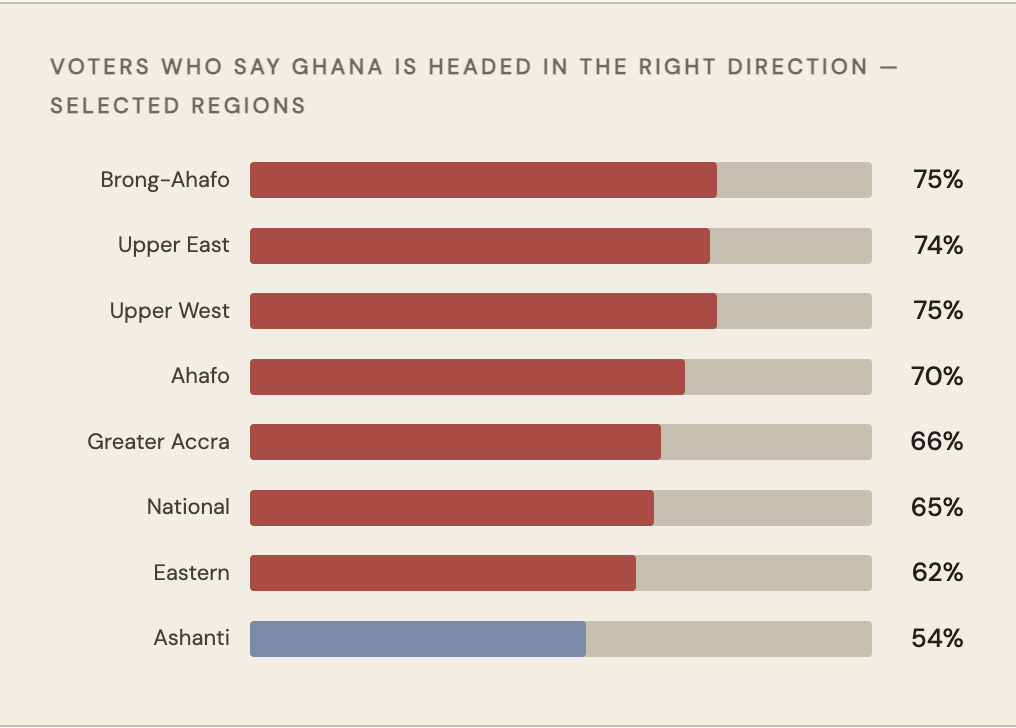
The regional breakdown tells an important story about where public confidence is strongest and where doubts are beginning to cluster.
The Ahafo Region leads all regions in right-direction sentiment at 70%, followed closely by the Brong-Ahafo and Upper East Regions at 75% and 74%, respectively.
The Ashanti Region, long the heartland of the opposition NPP, trails the national average at 54% — the lowest of any region. The Greater Accra Region sits at 66%, broadly aligned with the national figure.
Party affiliation, unsurprisingly, is the most powerful predictor of national outlook. Among NDC voters, a sweeping 90% say the country is headed in the right direction. Among floating voters — the crucial, movable middle of Ghanaian politics — that number drops to 59%, still a majority but a more fragile one.
Among NPP voters, only 26% see a country moving in the right direction, with 66% saying it is heading in the wrong one.
A Government Seen to Be Improving — and Sharply
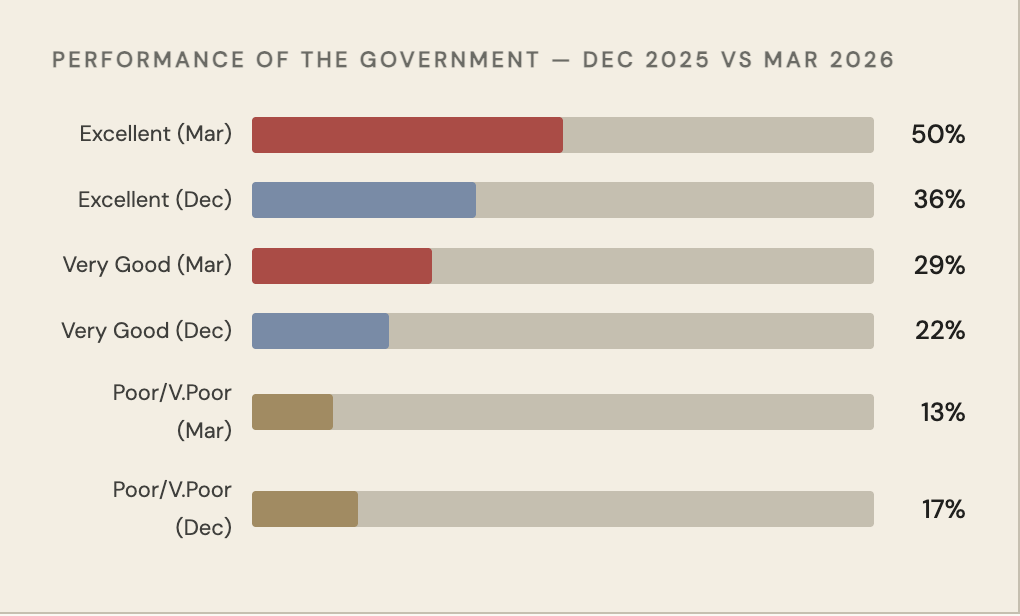
In December 2025, 36% of voters rated the government’s performance as “Excellent.”
By March 2026, that figure had climbed to 50% — a fourteen-point jump in a single quarter that represents one of the most significant positive shifts in the entire polling series.
The share of voters rating government performance as “Very Good or Good” rose from 22% to 29%. Meanwhile, the “Poor or Very Poor” rating dropped from 17% to 13%.
At every tier of the performance scale, the trend moved in the government’s favour. The “Average” rating — the middle ground — held broadly stable, edging from 22% to 11%, suggesting that many voters who previously sat on the fence have shifted to more clearly positive assessments.
Members of Parliament have also seen their ratings improve, though from a lower baseline.
The share of voters rating their MP’s performance as “Excellent” rose from 32% to 48%.
Still, the “Poor or Very Poor” rating for MPs sits at 19%, compared to 13% for the government overall — a reminder that parliamentary representation continues to carry a distinct and somewhat harsher verdict from citizens.
Living Standards: Better Today, But Tomorrow Is Less Certain
One of the most revealing findings in the poll concerns the divergence between voters’ assessments of their current standard of living and their expectations for the future — a gap that polling analysts often treat as an early-warning indicator of shifting public sentiment.
On the present, the picture is broadly positive. Fifty-eight percent of voters say that compared to a year ago, their standard of living has improved — up two points from 56% in December.
The share saying it has worsened dropped from 27% to 16%, and the share saying it remains unchanged fell from 12% to 3%. By these retrospective measures, Ghanaians are feeling better off.
But look forward, and a subtle unease emerges. When asked whether they are optimistic their standard of living will improve in the next twelve months, the share saying “yes” dropped from 70% to 68%. Two points may seem modest, but it represents a reversal of the forward-looking confidence that had been building throughout 2025.
The Corruption Question: Confidence Holds, But the Narrative Is Contested
On corruption — perennially one of Ghana’s most politically charged governance issues — the poll presents a nuanced, even conflicted, picture.
Sixty percent of Ghanaians say the government is fighting corruption effectively, a figure that has held exactly flat since December.
Half of all voters say the state of corruption in the country has improved, and that figure too has remained unchanged at 56%.
Yet beneath that stability, there is movement that the government cannot afford to ignore. The share of voters who say corruption has worsened under the current administration rose from 17% to 21% between December and March — a four-point increase in a single quarter that, if it continues, could begin to erode one of the government’s strongest claims to public confidence.
Opposition Heartlands Are Not Immune to Mahama’s Appeal
Perhaps the most politically striking finding in the presidential approval data is the breadth of Mahama’s support beyond traditional NDC territory.
In the Ashanti Region — the historic stronghold of the NPP and the region most closely associated with opposition to the current government — 56% of voters approve of the president’s performance.
In the Eastern Region, another area with significant NPP support, the approval figure stands at 64%. The North East Region registers at 65%.
Across all sixteen regions, a majority of voters approve of the president’s job performance.
The highest approval ratings are recorded in the Western Region at 78% and Ahafo at 76%, while the Ashanti Region and Western North Region — at 56% and 66% respectively — mark the lower ends of the scale, though still above the majority threshold.
Source: Global InfoAnalytics national tracking polls. Oct 2024 data refers to then-President Akufo-Addo. Feb 2025 (early) poll conducted Jan 30–Feb 1; Feb 2025 (mid) conducted Jan 27–Feb 16.
Significantly, among floating voters — the segment that swung the 2024 election decisively in the NDC’s favour — 62% approve of Mahama’s performance, while 30% disapprove.
Maintaining the loyalty of this cohort will be the central electoral task of the government’s remaining years.
The fact that only 26% of NPP-affiliated voters disapprove, compared to the expected 63%, suggests the opposition has not yet consolidated a coherent alternative narrative.
This article was edited with AI and reviewed by human editors