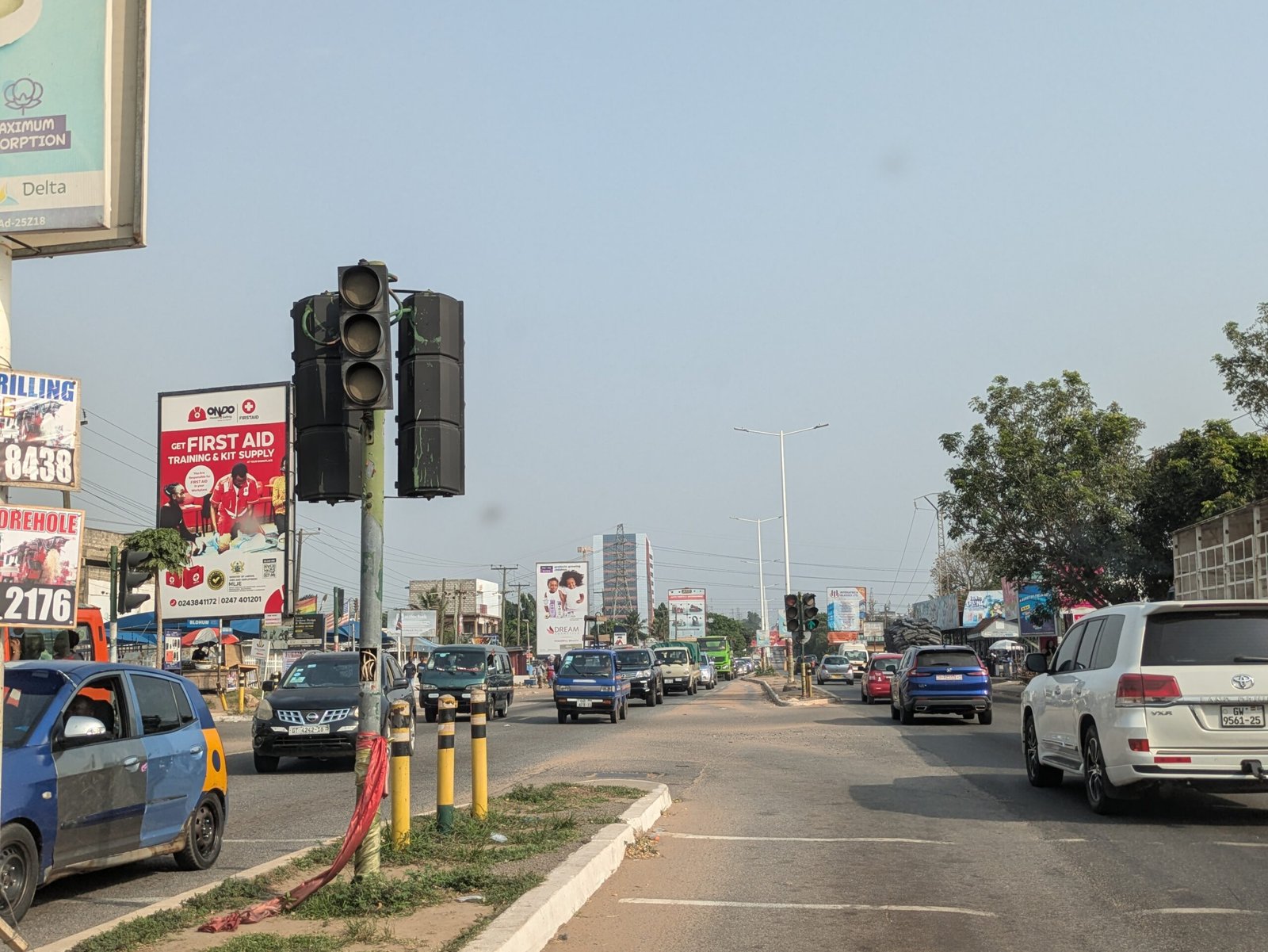
Almost every evening during rush hour, police officers wearing yellow vests stand at popular intersections in Accra, directing the flow of traffic from different sides.
The traffic lights (which are working and functional) are temporarily obsolete, as commuters follow the commands of the police officers telling them when to go and when to stop.
The consistent presence of police officers is to help relieve long stretches of traffic during rush hour in the city, which has gradually gotten worse over the years.
But this is not what was envisioned when the government, years ago, embarked on a project to enhance traffic navigation with the introduction of a traffic light management system.
The “Smart Traffic Management System,” which was officially inaugurated in 2020, promised to end the legendary gridlock of Accra.
The system would utilize sensors and real-time data to adjust signal timings based on actual vehicle flow, theoretically replacing the standard timer of the traffic light.
Six years later, Accra commuters are still facing the same traffic situation, resorting to the use of police officers instead of technology.
A Digital Solution for a Physical Problem
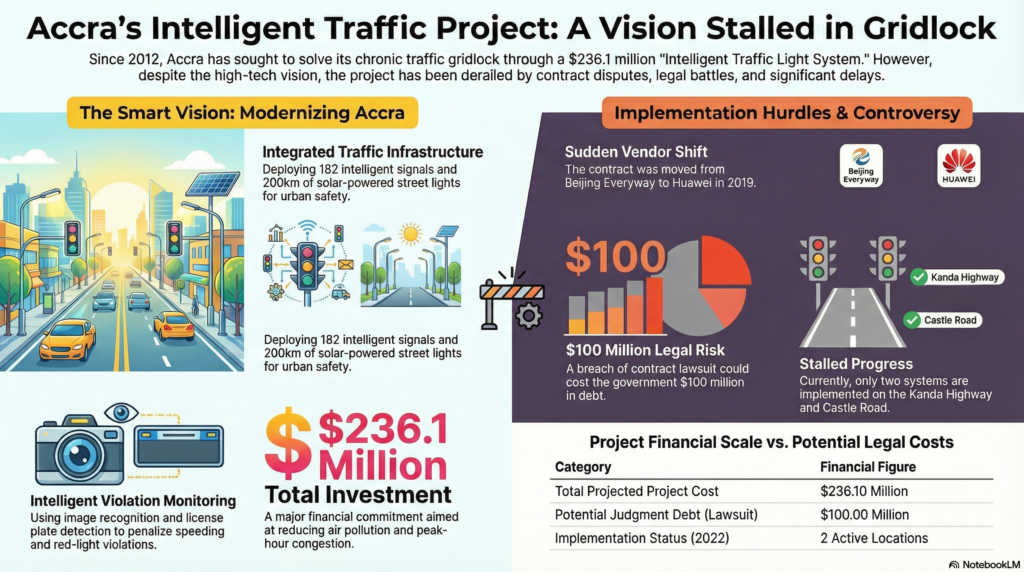
A contract for the traffic management system was signed way back in 2o12 during the first John Mahama administration. A company called Beijing Everyway was contracted to help install the system.
Early progress of the project was hampered by alleged government delays in payments, leading the contractor to issue notices for extensions.
In 2020, the Akufo-Addo administration controversially re-awarded the project to Huawei Technologies and China National Technical Import and Export Corporation (CNTIC).
Project oversight of the system was also shifted from the Ministry of Roads and Highways to the Ministry of National Security.
Lawsuit from Contractor
Beijing Everyway initiated arbitration in 2021–2022 at the Permanent Court of Arbitration (PCA) under UNCITRAL rules, invoking the 1989 China-Ghana Bilateral Investment Treaty (BIT).
They claimed alleged unlawful expropriation, breach of fair and equitable treatment, and umbrella clause violations (failure to honor contract).
They sought $55 million in damages for incurred costs.
Ghanaian officials argued the tribunal lacked jurisdiction, as the BIT’s dispute clause (Article 10) limited arbitration to the amount of compensation for expropriation—not its legality or other breaches.
On January 30, 2023, the tribunal unanimously upheld Ghana’s jurisdictional objections and dismissed the case.
No merits were considered, and Ghana avoided the potential $55 million payout.
Gridlock Continues
Despite the lawsuit win, implementation of the smart traffic light system remains limited.
While the project boasts of dedicated cameras at various intersections around the city, commuters are still stuck with the same old traffic lights based on timers.
As of now, police officers still stand at intersections at rush hour, directing traffic to help ease congestion.
For a project that is essentially more than a decade old and is estimated to cost almost $100 million, it feels like not much has been achieved to unlock Accra’s traffic grid.
It might not be unfair to say that the smart traffic light system is officially a bust.