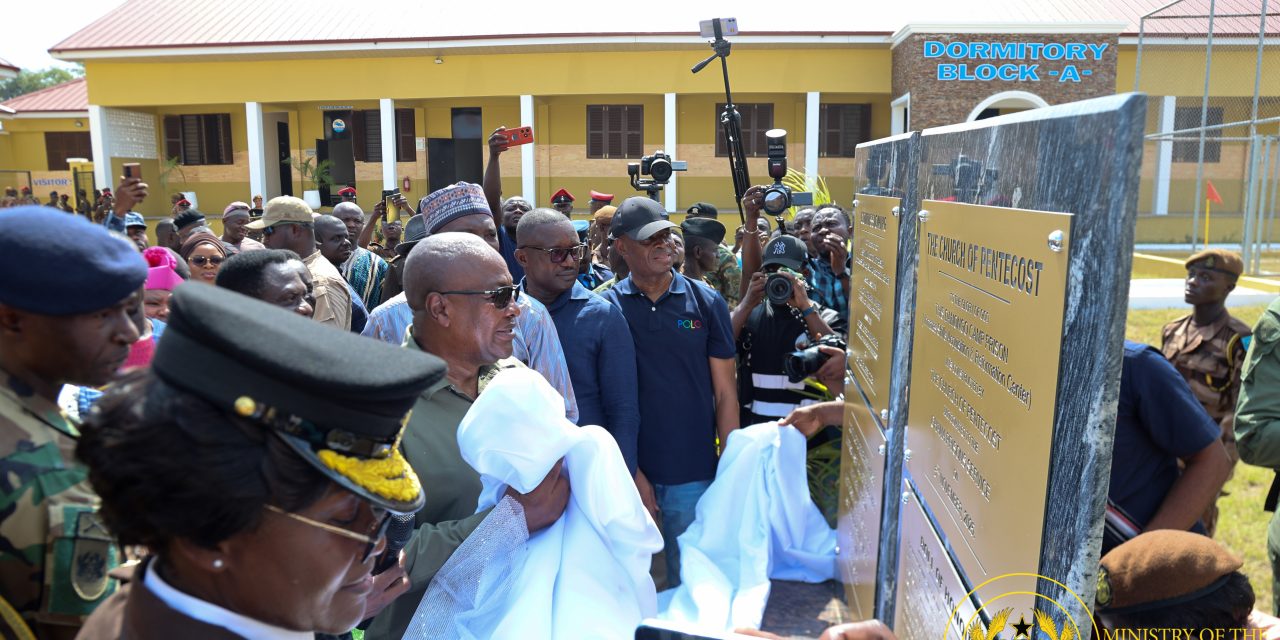
On Wednesday, November 5th, the Church of Pentecost (CoP), Ghana’s largest Pentecostal denomination with over 3 million members, handed over its Damongo Camp Prison Center to the Ghana Prisons Service.
President John Dramani Mahama was present to commission the 300-capacity correctional facility.
“On behalf of the Government and People of Ghana, I wish to express our deep gratitude to Apostle Eric Nyamekye, the Chairman of The Church of Pentecost, the leadership and members of the Church of Pentecost,” he said in a speech.
“Your faith in humanity, your partnership with the state, your belief in Mandela’s dictum, that ‘society’s greatness is measured by how it treats its most vulnerable citizens.”
The goal of the camp is to provide inmates with vocational training in various trades to support their successful reintegration into society after release. It also aims to alleviate the severe overcrowding issues in the country’s prisons.
The church’s construction of the camp has raised questions about the separation of church and state in Ghana.
The Damongo facility will be the church’s third such project — following similar centers in Ejura (2021) and Nsawam (2022).
State of Ghana Prisons
Ghana’s prisons are a humanitarian crisis.
In Nsawam prison, over 3,000 inmates are crammed into facilities built for 700.

Recently, the Ministry of Interior increased the daily feeding of prison inmates from 1.80 GHC to 5 GHC. A much-needed upgrade, but still regarded as inadequate for feeding adult prisoners.
The Chairman of the Church of Pentecost, Apostle Eric Nyamekye, responded to the controversy of the church entity building the prison camp.
In an interview, he stated that the Church’s initiatives are rooted in the understanding of the gospel’s call to care for the marginalised.
“Our greatest motivation in going to prisoners and building such facilities of comfort is from Hebrews 13:3, which says, ‘Continue to remember those in prison as if you were together with them in prison‘,” he said.
Alterior Motives?
Not everyone sees the Church’s prison initiatives as a positive development. The projects first sparked outrage in 2019, when the CoP broke ground at Nsawam.
Gospel musician Nacee, whose hits top Christian charts, added his critique in a radio interview: “In my candid opinion, it’s wrong for a church to build a prison in Ghana,” he said. “Instead, I will rather suggest that the church should build factories [to create jobs] so that our members and others will have gainful employment.”
Comedian Kweku Sintim-Misa (KSM) quipped on social media about the irony of a church building a prison.
“The government builds a Cathedral and the church builds a prison. Only in Ghana,” he said on the X platform.
Political Dividends
In Ghana, political parties have courted major churches and Christian leaders to secure votes in general elections.
Some critics say Pentecostal leaders willingly wade into politics to push their own agendas and influence Government.
In 2023, CoP elders floated a “Christian Morality Council” to police public behavior, drawing secular ire for encroaching on governance.
The church has also supported the controversial anti-LBGTQ legislation, even threatening to campaign against lawmakers who delay passage of the bill into law.
(Christian) Church and State
Even though Ghana is generally considered a secular state, most Ghanaians identify as Christians.
According to the 2021 census, about 71% of the population is Christian, with Muslims making up 19%.

Some leading Christians have been vocal about seeing more Christians govern the country and all of society according to biblical law.
Archbishop Nicholas Duncan-Williams, leader of the Action Chapel, one of the most prominent charismatic churches in the country, echoed those sentiments in a 2019 interview.
“Christians should rule in corporate, politics, the marketplace, everywhere“, he said.
As politicians become more intertwined with religious bodies, the line between church and state becomes more blurry.
When former President Nana Akufo-Addo announced the controversial National Cathedral, the lines were further blurred, with the president saying the Cathedral was a “testament of God’s goodness“.
At the commissioning of the prison camp, President Mahama praised the Church of Pentecost for turning faith into practical compassion, describing the project as proof that nation-building is a collective moral duty, not the work of government alone.
But if the church continues to build structures and gain more influence with the state, will the lines between the two entities continue to exist?
If church leaders can threaten to vote out lawmakers if they don’t agree with their positions in society, Christian leaders will have all the leverage.