


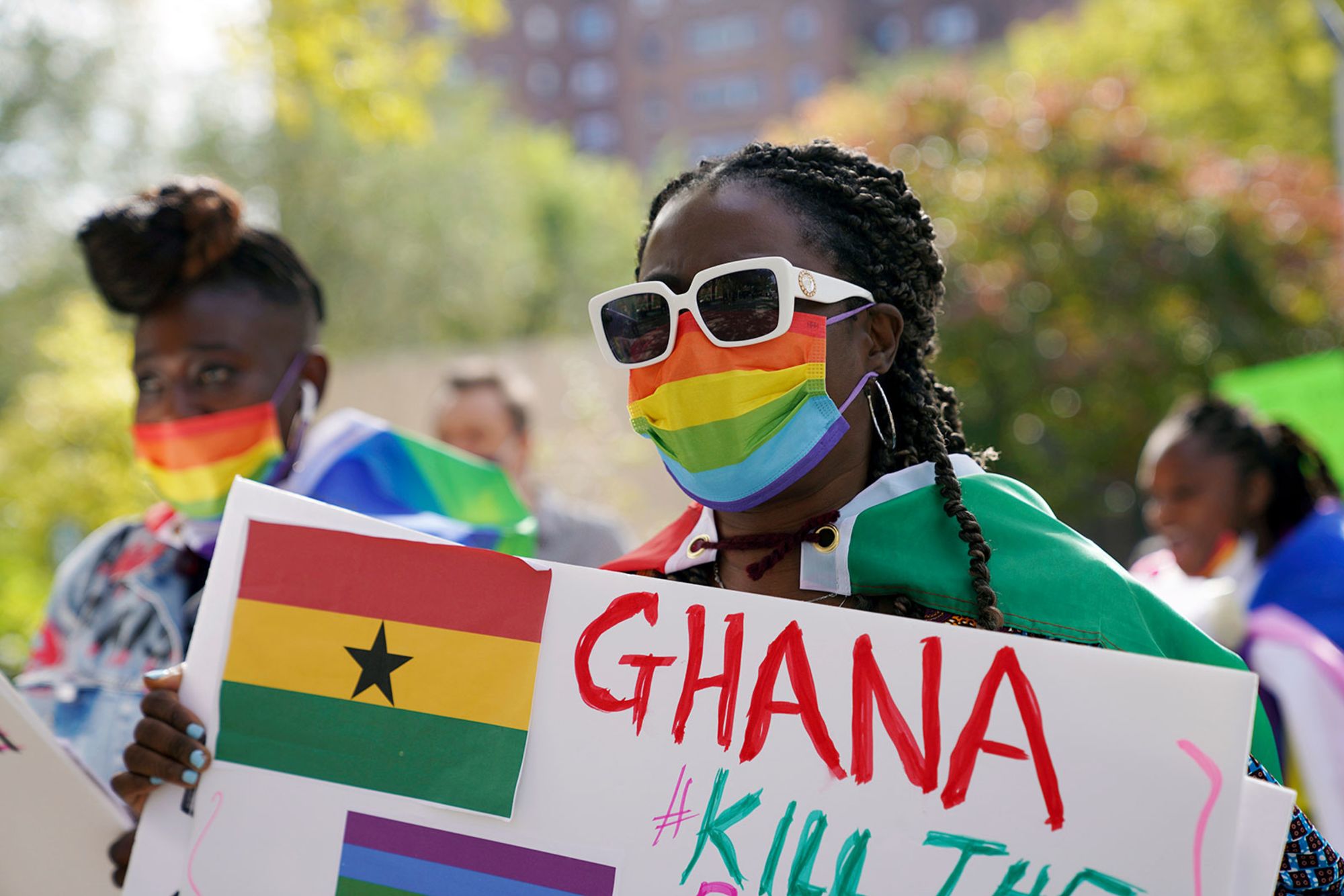
STORY HIGHLIGHTS
- Ghana’s Parliament passed the Human Sexual Rights and Family Values Bill on May 29, 2026, on a voice vote with only 32 of 276 MPs present
- More than 100 civil society organisations across Africa have called on President Mahama to return the bill to Parliament for a full sitting and genuine public process
- Critics say the bill’s professional exemptions fail to address the chilling effect on patients seeking healthcare, citing a 25% drop in HIV treatment consultations in Senegal after comparable legislation
- The bill, partly enabled by US-based evangelical organisations, criminalises same-sex identification (up to 3 years) and promotion of LGBTQ activities (up to 10 years)
ACCRA, Ghana — On the evening of May 29, 2026, Ghana’s Parliament passed one of the most consequential pieces of social legislation in the country’s recent history.
The Human Sexual Rights and Family Values Bill cleared Parliament on a voice vote after the Constitutional and Legal Affairs Committee unanimously recommended its adoption, with First Deputy Speaker Bernard Ahiafor announcing the result.
Thirty-two members were present. There are 276 seats.
Landmark legislation that imposes prison sentences of up to three years for individuals identifying as LGBTQ and up to ten years for promoting or supporting LGBTQ activities moved from introduction to passage without the deliberative record being available to the public it purports to govern.
No quorum objection was raised on the floor.
Proponents have since presented that silence as the matter being settled. A coalition of more than 100 civil society organisations disagrees, and they are saying so directly to the President.
The Coalition’s Case
In a joint statement addressed to President John Dramani Mahama, the organisations — operating across Africa — called on him to send the bill back to Parliament with instructions for a full sitting and a genuine public process before any further vote is taken. Their message is blunt: “#BackToSender.”
The coalition’s critique is threefold. It challenges the procedural legitimacy of a thin-quorum voice vote on legislation of this gravity.
It disputes the claim that the bill’s professional carve-outs — for healthcare workers, lawyers, and media professionals — adequately address its human rights consequences.
And it questions the framing of the bill as a defence of sovereign Ghanaian values, given the documented financial involvement of foreign organisations in its promotion.
The Exemptions That Change Nothing
The bill’s supporters have pointed to those carve-outs as evidence of proportionality. The coalition is unconvinced, and for a reason the exemptions themselves cannot address: the chilling effect operates before the clinic door, not inside it.
The statement draws on Senegal as a cautionary case.
Following comparable legislation enacted earlier this year, HIV treatment consultations across Senegal’s treatment sites fell by over 25% within a single month.
Patients returned their antiretroviral medication boxes rather than risk collection. A country that had reduced HIV prevalence to 0.3% is watching that progress unravel — not because doctors began reporting patients, but because patients stopped coming.
The professional exemption had nothing to say about that.
Ghana’s bill also does not answer what a clinician may do with suspicion, as opposed to knowledge. In that silence, every frontline worker becomes a risk to be navigated rather than a resource to be trusted.
Foreign Money, Domestic Legislation
The bill is framed, consistently and deliberately, as a defence of Ghanaian family values. The coalition’s statement complicates that framing.
The 4th African Inter-Parliamentary Conference on Family and Sovereignty, hosted in Accra in deliberate alignment with the bill’s passage, was organised and financed in significant part by Family Watch International, CitizenGO, and the Alliance Defending Freedom — US-based far-right advocacy groups with documented ties to promoting Uganda’s Anti-Homosexuality Act as a model for other African legislatures.
The coalition draws a pointed contrast.
Two months ago, Ghana led a historic United Nations resolution declaring the transatlantic slave trade among the gravest crimes against humanity.
That resolution named precisely what it means for a people’s sovereignty to be overridden by external actors with resources and reach.
The same Parliament, in the same season, appears to have allowed external actors with resources and reach to help shape its domestic legislation.
Ghana’s Democratic Credibility on the Line
The coalition’s statement closes on the question of democratic precedent. Ghana is a country others on the continent look to. Its democratic credentials are not a domestic matter alone; they are part of what Ghana projects and what Africa has learned to rely on.
If landmark social legislation affecting millions of lives can be passed in an emptied chamber — and the response is a procedural shrug — the coalition argues that the standard needs to be explicitly owned, not quietly assumed.
Their ask is straightforward: if this legislation truly carries the will of Ghanaians, it has nothing to fear from transparency. And if transparency is what is being avoided, Ghanaians are owed an explanation.
President Mahama has not yet signed the bill into law. His next move will define far more than a single piece of legislation.



Follow