


Story Highlights
- The 2025 State Ownership Report shows Ghana’s 53 profiled state enterprises earning a combined GHS21.8 billion net profit on GHS147.5 billion in revenue
- Ten entities account for roughly GHS25 billion of that profit — more than the portfolio’s entire net total — meaning the rest of the portfolio is a wash
- Newly created Ghana Gold Board, which absorbed the old Precious Minerals Marketing Company mid-year, is the single largest profit contributor
- The Electricity Company of Ghana posted an operating loss of GHS14.35 billion — the worst in the portfolio — but a currency gain cut its bottom-line loss nearly in half
- Seven entities have negative equity, and one, Tema Oil Refinery, posted a profitable year while remaining GHS4.5 billion in the hole
Ghana’s State Interests and Governance Authority (SIGA) reported that the country’s 53 individually profiled state-owned enterprises earned a combined net profit of GHS21.8 billion in the 2025 fiscal year, against GHS147.5 billion in operating revenue and GHS383.2 billion in total assets, according to the 2025 State Ownership Report.
On its face, the figure suggests a state enterprise sector turning a healthy corner. A closer reading of the underlying entity-level data complicates that picture considerably.
Thirty-three of the 53 entities were profitable in FY2025; twenty posted losses. But the aggregate surplus is not evenly earned.
Ten entities — led by the newly formed Ghana Gold Board, the Ghana Cocoa Board, the Ghana National Petroleum Corporation and the Ghana Education Trust Fund — together generated close to GHS25 billion in net profit, more than the entire portfolio’s net total.
That arithmetic means the remaining 43 entities, taken together, roughly cancel each other out. The “GHS21.8 billion” headline, in other words, describes a handful of large winners offsetting a much larger group of marginal performers and loss-makers, not broad-based improvement across the state sector.
A New Entity Inflates the Top Line
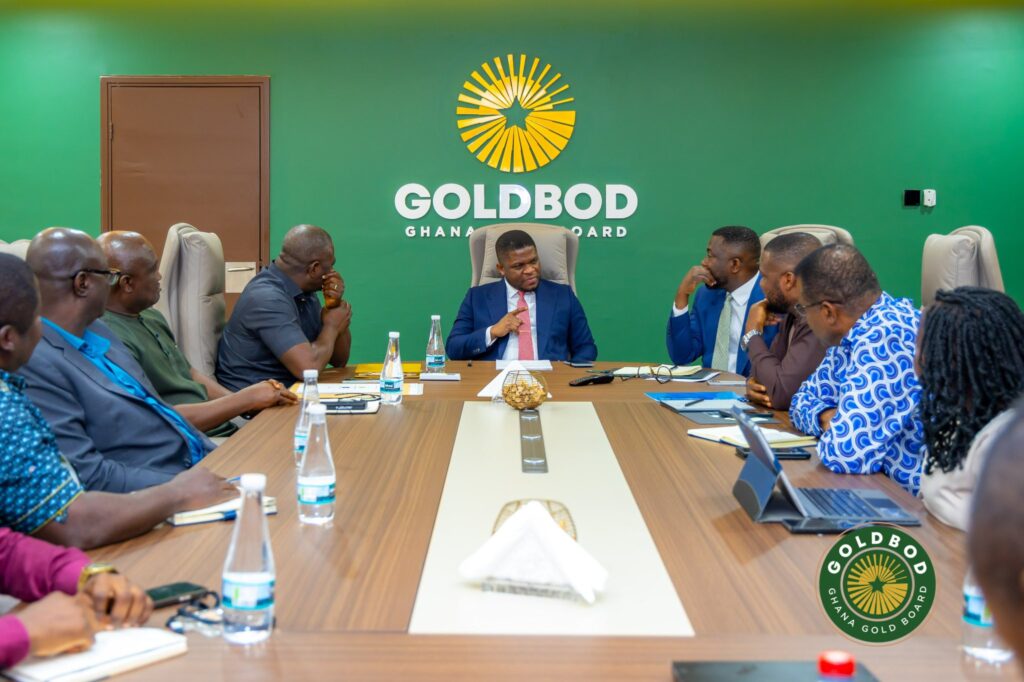
The single largest profit contributor in the FY2025 accounts is Ghana Gold Board, known as GoldBod, which posted a net profit of GHS5.44 billion.
GoldBod did not exist as a standalone entity for most of its comparison period. It was created under Act 1140 in 2025 and absorbed the assets, liabilities and workforce of the former Precious Minerals Marketing Company, according to the report’s own description of the entity.
That distinction matters for how the figure should be read. GoldBod’s profit reflects a restructured entity’s first year of operating under a new mandate to regulate and manage gold buying, assaying and export — not year-over-year growth at an existing company.
Comparing its FY2025 result to prior years, as the report’s trend tables implicitly invite readers to do, is comparing two different organizations under one name.
Strip out GoldBod and the Ghana Cocoa Board — which alone accounts for 33 percent of all SOE revenue, GHS48.6 billion of the GHS147.5 billion total — and the remaining 51 entities net closer to GHS11.3 billion.
That is still a positive result, but roughly half the headline figure, and a far less dramatic story about the health of Ghana’s state enterprise portfolio.
Where the Money Actually Sits
Asset concentration tells a similar story. The Electricity Company of Ghana and the Volta River Authority alone hold 38 percent of total SOE assets; add the Cocoa Board and three entities control 46 percent of the portfolio’s asset base.
The energy sector as a whole — ten entities — accounts for 66 percent of total assets. Any assessment of “the SOE sector’s” financial health is, in practice, largely an assessment of a small number of energy and commodity institutions.
ECG’s Improved Loss Is a Currency Story, Not a Turnaround
The most consequential single figure in the report may be the one attached to the Electricity Company of Ghana.
ECG’s Operating Results, the report’s measure of operating profit before financing and tax effects, came in at negative GHS14.35 billion for FY2025 — by far the weakest operating performance of any entity in the portfolio, and a sharp reversal from a positive GHS1.8 billion the year before.
Yet ECG’s net loss for the year narrowed to GHS2.52 billion, down from GHS8.26 billion in FY2024. The report attributes the improvement to a GHS12.16 billion foreign exchange gain tied to the cedi’s appreciation during the year, which offset the company’s weak operating performance below the line.
Read together, the two figures point in opposite directions. ECG’s core business — the buying and selling of electricity — deteriorated sharply in FY2025. Its reported bottom line improved only because of a currency movement outside its operational control.
A reader relying on the net loss figure alone would reasonably conclude ECG’s finances improved this year. The operating figure suggests the opposite.
Profitable on Paper, Insolvent on the Balance Sheet
Seven entities in the FY2025 accounts carry negative shareholders’ equity, a signal that accumulated losses over time exceed the value of what they own: the Road Maintenance Trust Fund (-GHS6.26 billion), Tema Oil Refinery (-GHS4.53 billion), AirtelTigo (-GHS3.24 billion), Ghana Water Limited (-GHS1.48 billion), GIHOC Distilleries, GNPA Limited and the Ghana Integrated Aluminium Development Corporation.
Tema Oil Refinery illustrates how a single profitable year can obscure a deeper structural problem. TOR posted a net profit of GHS1.09 billion in FY2025 — one of the ten largest in the portfolio — while remaining GHS4.53 billion in negative equity.
One strong year has not come close to reversing years of accumulated losses at the refinery.
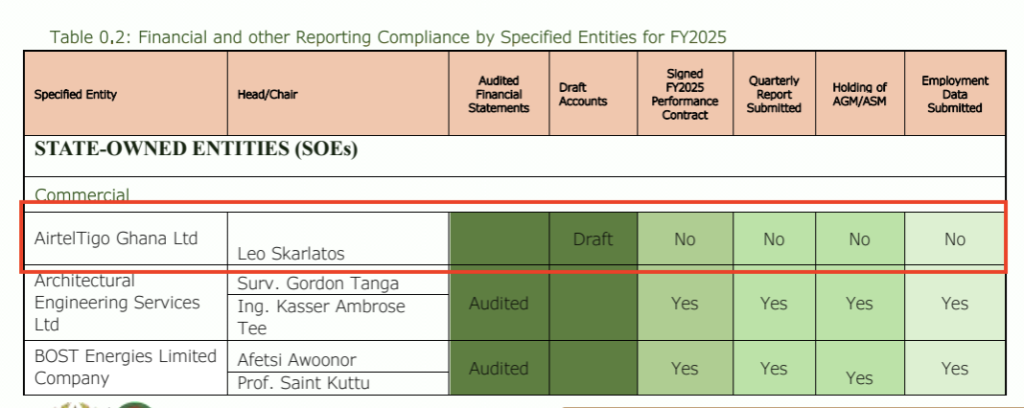
AirtelTigo presents the opposite pattern: a company still losing money (GHS352.56 million net loss in FY2025) with equity continuing to deteriorate, and now reportedly pursuing a merger with Telecel Ghana rather than an independent turnaround, according to the report.
A Sector Split by Currency and Commodity, Not Uniform Improvement
Grouped by sector, only Communications posted a net loss overall (-GHS358 million across six entities, driven almost entirely by AirtelTigo).
Every other sector was net positive — but in several cases, that positive result depends on one dominant institution rather than sector-wide health: Agricultural sector profit is essentially COCOBOD; Energy sector profit exists only because GNPC, GRIDCO and BOST outweigh ECG’s losses; Manufacturing’s profit is skewed by GoldBod’s classification.
This article was edited with AI and reviewed by human editors



Follow