Story Highlights
- Six Years in the Making: Ghana’s Cannabis Regulatory Programme launched on February 26, 2026 — six years after Parliament first passed the law enabling it, and after the Supreme Court struck down a key provision in 2022, stalling the industry before it began.
- The Fees Are in Dollars: All licensing fees are denominated in US dollars, not cedis. A cultivation licence for a five-hectare farm costs $225,000 upfront, plus a 20% annual regulatory fee every year after.
- No Breaks for Small Farmers: The fee schedule has no income-based exemptions, no subsidies, and no cooperative provisions. A smallholder and a conglomerate pay at the same rate.
- A Farmer Has Already Sued: One day after the launch, a farmer from Techiman filed a Supreme Court challenge arguing the fee structure amounts to executive taxation — a power the Constitution reserves exclusively for Parliament.
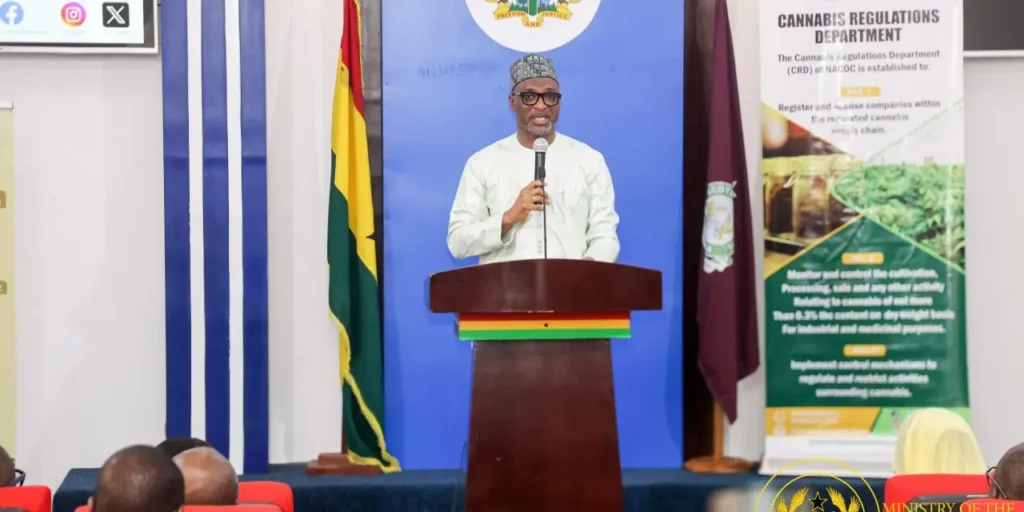
On the morning of February 26, 2026, Interior Minister Muntaka Mohammed-Mubarak stood before a room full of journalists, farmers, lawyers, and industry lobbyists in Accra and announced that Ghana was, finally, open for business.
Industrial cannabis cultivation — the growing of low-THC hemp for fibre, medicine, and export — was now a legal, licensed commercial activity.
It had taken six years to get there.
In March 2020, Ghana’s Parliament passed the Narcotics Control Commission Act, 2020 (Act 1019), which for the first time drew a legal distinction between marijuana and industrial hemp.
It defined hemp as cannabis with a THC content of no more than 0.3% on a dry weight basis, the same threshold used in the United States and the European Union.
The move was widely praised. Cannabis advocates, agricultural economists, and rural development experts pointed to the plant’s enormous commercial potential: fibre for textiles, seeds for food and cosmetics, CBD for medicine, and a legitimate income stream for farmers.
But almost as soon as Act 1019 was passed, it ran into trouble. In 2022, the Supreme Court struck down Section 43 of the law — the very provision that empowered the Minister of the Interior to grant cultivation licences — ruling it unconstitutional because it lacked adequate parliamentary debate.
The industry, which had barely started, stalled again.
Parliament eventually amended the law, passing the Narcotics Control Commission (Amendment) Act, 2023 (Act 1100), which clarified the licensing framework and restored the legal basis for the programme.
Accompanying regulations — L.I. 2475 — were gazetted. A fee schedule was approved. And on February 26, 2026, the Ministry of the Interior and the Narcotics Control Commission (NACOC) officially launched what they called the Cannabis Regulatory Programme.
This opened the door to an industry that had been promised, delayed, litigated, and promised again since the Mahama administration first introduced the concept nearly a decade earlier.
The door, it turned out, had a dollar-denominated price tag.
Dollar Fees, Not Cedis
The Schedule of Fees for Licences and Permits under the Cannabis Regulations runs to eight categories and more than a dozen individual line items. All fees are denominated in United States dollars.
To apply for a licence, a community pays $1,000. A company or business pays $5,000 — non-refundable, regardless of the outcome.
Cultivation licences begin at $9,000 for farms of up to 0.4 hectares (roughly one acre), rising to $11,500 per acre for farms between one and three acres, and $13,500 per acre for farms up to five acres.
Beyond five hectares, the rate locks at $45,000 per hectare — across eight categories stretching from five hectares all the way to farms exceeding fifteen thousand hectares.
Then come the annual regulatory fees: 20% of the base licence fee, every year. A cultivator with a five-hectare farm pays $225,000 to obtain their licence.
Each subsequent year, they pay an additional $45,000 just to remain in compliance. Processing licences range from $5,000 for small operations to $20,000 for larger ones. An export licence costs $10,000. Transport licences begin at $5,000 for a single vehicle, with $1,000 added per additional vehicle.
And all of these fees carry the same 20% annual regulatory surcharge.
Below is the full fee schedule as published:
| Licence Type | Fee (USD) |
|---|---|
| Application – Community | $1,000 |
| Application – Company/Business | $5,000 |
| Cultivation – Tier 1 (up to 0.4 ha) | $9,000 |
| Cultivation – Tier 2 (up to 1.2 ha) | $11,500/acre |
| Cultivation – Tier 3 (up to 2 ha) | $13,500/acre |
| Cultivation – Category 2–8 (5+ ha) | $45,000/hectare |
| Annual Regulatory Fee (all cultivation) | 20% of licence fee |
| Processing – Tier 1 (up to 200 sqm) | $5,000 |
| Processing – Tier 2 (over 200 sqm) | $20,000 |
| Export Licence | $10,000 |
| Import Licence | $5,000 |
| Laboratory Licence | $3,000 |
| Transport – 1st Vehicle | $5,000 |
| Transport – Each Additional Vehicle | $1,000 |
| Storage Licence | $10,000 |
| Breeding of Cultivar Licence | $3,000 |
The fees are not graduated by farm size, crop yield, revenue, or profit. A farmer with one acre pays at a per-acre rate. A conglomerate with two thousand hectares pays at the same per-hectare rate.
There is no income-based exemption, no subsidy mechanism, and no provision for farmer cooperatives — at least not in the regulations as drafted.
Controversially, every single fee is in US dollars, not cedis.
Unconstitutionality and Lawsuits
On February 27, 2026, Mariam Alhassan, a farmer from Techiman in Ghana’s Bono East Region, sued the government. Her lawyer, Amanda Clinton, had spent weeks preparing the filing. The defendants named in the suit were the Ministry of the Interior, the Narcotics Control Commission, the Ministry of Food and Agriculture, and the Attorney-General.
Alhassan’s case challenges the way the executive has exercised its administrative authority — and whether the resulting framework is constitutionally defensible when its practical effect is to reserve an entire legal industry for well-capitalised operators.

The suit invokes Articles 17, 23, 36, and 296 of Ghana’s 1992 Constitution. Article 17 guarantees equality before the law, and Article 23 mandates administrative justice and fairness.
Article 36 contains the directive principles of state policy, which commit the state to promoting economic development through local participation.
Article 296 governs the exercise of discretionary power, prohibiting its use arbitrarily or capriciously.
The most striking constitutional argument concerns Article 174, which vests the power to impose taxes exclusively in Parliament.
Alhassan’s legal team argues that the cumulative effect of the licensing fee, the annual regulatory fee, the processing fee, the export fee, the transport fee, and any required financial guarantees amounts, in substance, to taxation — and that this taxation has been imposed by executive regulation, not by parliamentary vote.
Waiting for the Court
The Supreme Court has not yet set a date to hear her case. Applications for cannabis licences are open at ncc.gov.gh, payable by Visa card, mobile money, or NIB Bank voucher — in US dollars.
The Cannabis Regulatory Programme is six years in the making. The legal framework has been struck down once and rebuilt. The fees have been approved by Parliament.
The portal is live. And the country is waiting — again — to find out whether this time the industry it promised will actually arrive.
The answer may come from a courtroom before it comes from a farm.
This article was edited with AI and reviewed by human editors