STORY HIGHLIGHTS
- Ghana is seeking to exercise pre-emptive rights over Lukoil’s 38% stake in the Deepwater Tano Cape Three Points block, which hosts the undeveloped Pecan oil field
- The move was triggered by Carlyle Group’s January 2026 agreement to acquire most of Lukoil’s international portfolio, estimated at $22 billion
- Shell is in talks to buy into the block’s local operating unit, Pecan Energies, which is owned by Africa Finance Corporation
- The bid fits a broader Mahama-era push to consolidate state control over Ghana’s petroleum assets
ACCRA, GHANA – For years, Russia’s Lukoil has been the awkward partner in one of Ghana’s most promising — and most stalled — offshore oil projects.
The Russian company’s 38% stake in the Deepwater Tano Cape Three Points (DWT/CTP) block has loomed over the Pecan field’s development as a geopolitical liability, complicating investment decisions and deterring international operators since Russia’s full-scale invasion of Ukraine in 2022.
Now, Ghana appears ready to turn that liability into an opportunity.
Ghana is considering using its pre-emptive rights to acquire Lukoil’s 38% stake in the Deepwater Tano Cape Three Points block, according to people familiar with the matter.
Ghana may exercise its right of first refusal to purchase the asset, especially after Carlyle Group agreed to acquire a significant portion of Lukoil’s international portfolio, which may include this project.
The Ghanaian government has already commissioned a valuation of the stake and informed the Russian company of its intention to exercise its right of first refusal. Additional investors may be brought in to finance the development of the fields.
Ghana’s Government has not commented publicly on the transaction. Lukoil and Carlyle have not publicly commented on whether the Ghanaian block was part of its deal.
The Pecan Field: Promise Deferred
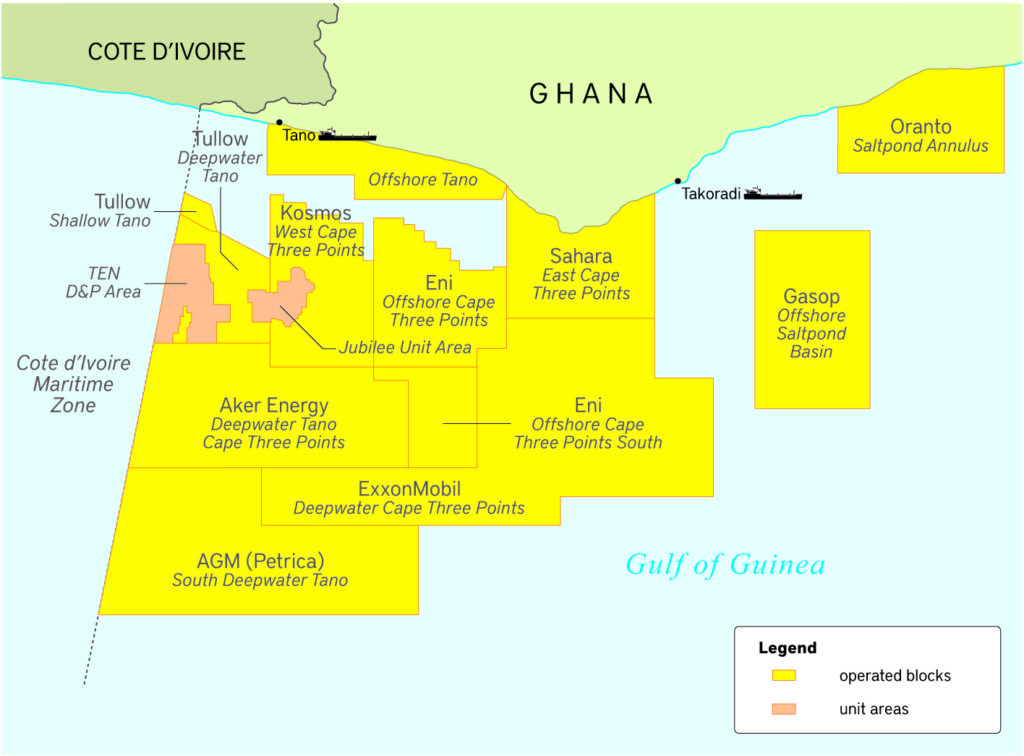
The Deepwater Tano Cape Three Points block hosts seven discovered fields — including the Pecan, Pecan North, Almond, Beech, and Cob oil fields — with Wood Mackenzie estimating recoverable resources across the block at 453 million barrels, making it Ghana’s top block by that measure.
The field is to be developed in two stages. Peak production could reach 80,000 barrels per day. Total capital investment is estimated at $3.5 billion, and the field’s reserves are estimated at 268 million barrels, while the entire DWT/CTP block is estimated at 550 million barrels.
Despite that potential, Pecan has never produced a barrel.
President John Mahama has described Pecan as a potential “game changer” for Ghana’s energy sector, stressing that if development proceeds on schedule, the field could come onstream within the next three to four years, dramatically boosting Ghana’s oil output.
The block’s current ownership structure reflects years of turbulence. Africa Finance Corporation became the sole shareholder in Aker Energy and holder of a 50% stake in DWT/CTP when Oslo-based Aker Energy exited the project in 2023.
Lukoil Overseas Ghana Tano Limited owns 38%, Ghana National Petroleum Corporation (GNPC) holds 10%, and Fueltrade Limited has 2%. Aker’s exit had itself been precipitated in large part by the complications of being a co-venturer with a sanctioned Russian entity.
Bigger Stakes in a Familiar Battle
Ghana’s push mirrors a wider continental ambition. GNPC has been looking, at least rhetorically, to become more — rather than less — involved in oil and gas activities by taking on a more leading role in driving exploration and production, in order to sustain oil export revenues and ensure domestic supplies of gas.
GNPC’s oil production has declined in recent years after a peak in 2019, and current oil reserves will last for only nine years at current production rates. Pecan, if developed, would be the most significant addition to Ghana’s production profile in a decade.
The window created by Russia’s forced divestment may not stay open long. With Carlyle circling and Shell in talks, the question for Ghana is whether it can move fast enough — and fund credibly enough — to claim a stake that could reshape the country’s petroleum future.
This article was edited with AI and reviewed by human editors