


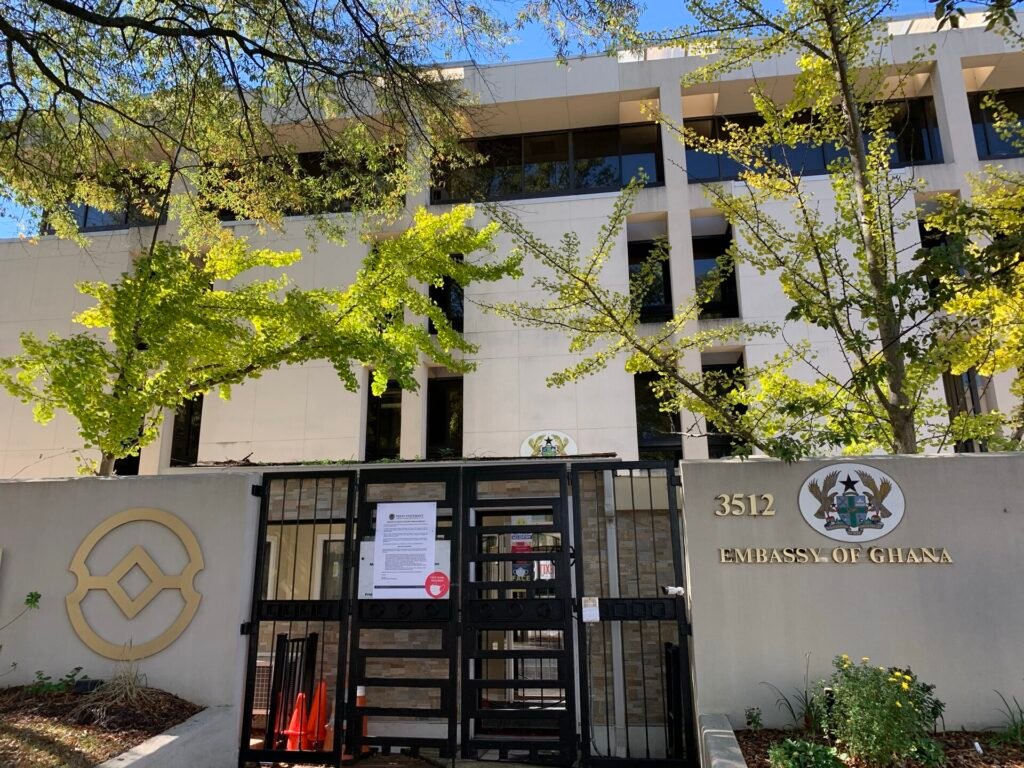
Story Highlights
- A special audit by Ghana’s Auditor-General has quantified US$19,379,765.23 in irregular financial exposure at the Embassy of Ghana in Washington, D.C., covering January 2017 to June 2025.
- Investigators say a temporary ICT officer, Fred Brian Kwarteng, used unauthorized websites mimicking the embassy’s official site to redirect visa and passport applicants into paying inflated mailing and “application support” fees.
- The report also flags a US$295,907.84 payment to a company linked to the same officer, misuse of an embassy welfare account, an unapproved payment gateway, and missing passport booklets found in the officer’s office.
- Auditors say senior mission officers — including a former Chief Treasury Officer, two Ministers (Consular), and the former Ambassador — either facilitated or failed to stop the scheme, and have recommended disciplinary and legal action.
A special audit of the Embassy of Ghana in Washington, D.C., has uncovered what the Auditor-General describes as a systemic diversion of consular revenue spanning nearly the entire period between 2017 and mid-2025.
The report, submitted to Parliament under Section 16 of the Audit Service Act, 2000 (Act 584) and signed by Auditor-General Johnson Akuamoah Asiedu on 1 April 2026, puts the total financial exposure at US$19,379,765.23.
The audit examined bank records, internal emails, consular databases and forensic transaction data covering the mission’s handling of visa and passport processing, one of Ghana’s largest diplomatic operations abroad.
Investigators concluded that the bulk of the loss stemmed not from a single theft but from a prolonged operational structure in which applicants were routed away from official channels toward privately controlled platforms.
The Website Redirects
At the center of the findings is Fred Brian Kwarteng, who served as the embassy’s temporary Information and Communication Technology Officer from November 2016 until his contract was terminated in May 2025.
According to the audit, Kwarteng had administrative-level access to the embassy’s website, ghanaembassydc.org, and used it between 2019 and 2025 to embed hyperlinks and pop-up notices directing applicants to run platforms, including GhanaPV.org and TravelGhana.net privately.
Auditors found that GhanaPV.org, created in September 2020, replicated the Coat of Arms of Ghana and other official embassy branding to appear legitimate.
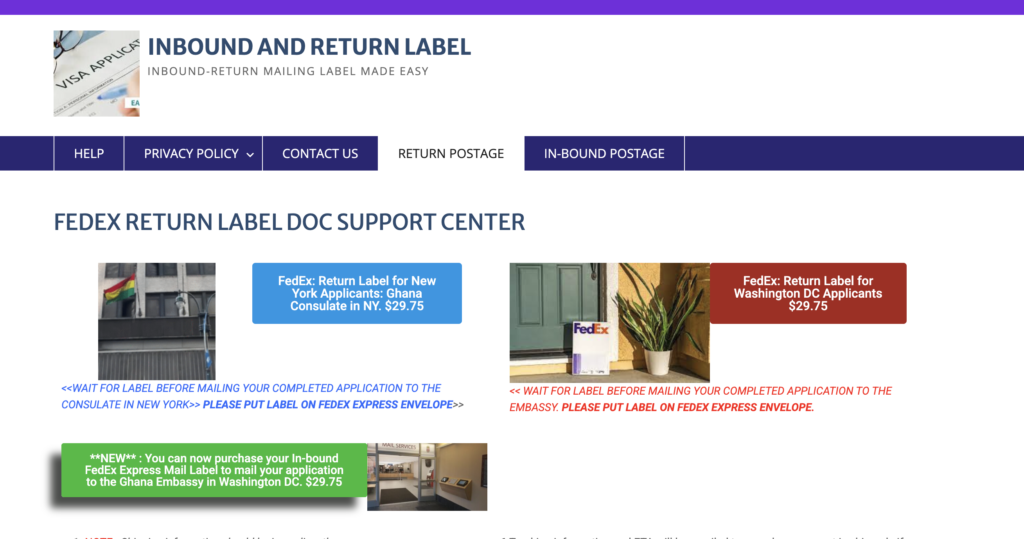
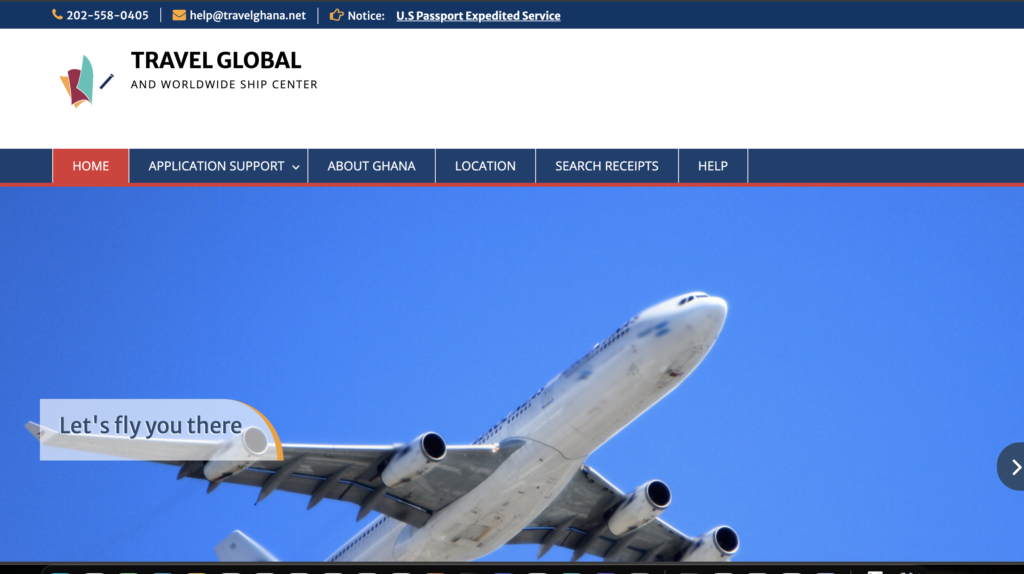
Both platforms charged applicants mandatory fees — $29.75 for return postage and between $67 and $76.78 for “application support” services — after the embassy discontinued the standard practice of accepting self-addressed prepaid envelopes.
The report notes that group dispatch of documents was also restricted, a change auditors say management could not justify.
Based on application volumes recorded in the embassy’s electronic consular systems, the audit estimates applicants paid roughly $21.3 million in mailing and support fees between 2019 and 2025.
After allowing for the embassy’s actual postage costs, auditors calculated the diverted proceeds at $18,979,460.30, with the largest single component — $14.3 million — coming from the “application support” charges alone.
The $19.4 Million Gap
A line-by-line breakdown of estimated proceeds versus estimated cost across visa and passport mailing fees, application support services, and flagged transactions — showing where the numbers stop adding up.
| Component | Qty | Rate | Est. Proceeds (US$) | Est. Cost (US$) | Difference (US$) |
|---|---|---|---|---|---|
| eCIMS Data Analysis | |||||
| Mailing (Dispatch and Handling) Fees | |||||
| Visa Mailing | 170,533 | $29.75 | 5,073,356.75 | 1,722,383.30 | 3,350,973.45 |
| Passport Mailing | 18,598 | $29.75 | 553,290.50 | 187,839.80 | 365,450.70 |
| AppTrack Data Analysis | |||||
| Mailing (Dispatch and Handling) Fees | |||||
| Visa Mailing | 39,320 | $29.75 | 1,169,770.00 | 397,132.00 | 772,638.00 |
| Passport Mailing | 5,013 | $29.75 | 149,136.75 | 50,631.30 | 98,505.45 |
| Passport/Visa Application Support Services (2021–2025) | |||||
| Visa Support — $68.78 to $76.78 | 188,050 | $68.78 | 12,934,079.00 | – | 12,934,079.00 |
| Passport Support — $67 | 21,079 | $67.00 | 1,412,293.00 | – | 1,412,293.00 |
| Additional Postage Cost for the Embassy (June–August 2025) | 45,520.70 | – | 45,520.70 | ||
| Extra Merchant Fees for Online Payment Gateway: Square (2020–2025) | 104,397.09 | – | 104,397.09 | ||
| Transactions Involving Fred Kwarteng & STEFRANN LLC (2019–2020) | 295,907.84 | – | 295,907.84 | ||
| TOTAL | 21,737,751.63 | 2,357,986.40 | 19,379,765.23 | ||
Additional Financial Irregularities
The audit identified several further irregularities tied to the same period. Applicants using the embassy’s Square payment gateway between 2020 and 2025 were charged merchant processing fees 19 to 52 percent above Square’s published rates, generating an estimated $104,397.09 in excess charges.
Auditors say Square itself was engaged as a payment processor for two years without a formal contract or Foreign Affairs Ministry approval, with a proposal recommending its use submitted only after the platform was already processing roughly $30,000 a day.
Separately, the embassy made two payments totalling $295,907.84 in 2019 and 2020 to a company called STEFRANN LLC, which the then Chief Treasury Officer, Janet Maku Koranteng, confirmed was linked to Kwarteng.

The payments, made for renovation work at the Ambassador’s residence, were flagged as suspicious by Citibank over questionable invoices and conflict-of-interest concerns; auditors say later searches could not confirm the company’s existence under that name.
A related finding describes proceeds from these transactions being shared through the embassy’s welfare account.
Passport Security and Governance Gaps
Beyond the financial figures, auditors uncovered serious lapses in physical security controls. During the 2025 forensic review, investigators say they found 15 passport booklets — including four blank biometric booklets — along with used and unused visa stickers in Kwarteng’s office, outside the mission’s authorized storage system.
An earlier internal audit in May 2021 had already flagged discrepancies in passport inventory, but the report indicates no corrective action followed.
The audit also faults the embassy’s contracting practices. A January 2023 agreement outsourcing dispatch services to Travel Ghana / Secure Data Center was signed by then-Ambassador Alima Mahama without Ministry vetting, and auditors note the contracting entity was formally incorporated only after the contract date.

Three ICT systems used by the mission, including its accounting software, reportedly had no procurement documentation, contracts, or evidence of payment.
Senior Officers Implicated
The report goes beyond Kwarteng to examine the conduct of senior mission personnel. It states that Koranteng, as Chief Treasury Officer between 2017 and 2023, engaged directly with Citibank over compliance questions involving the welfare account and STEFRANN LLC.
Genevieve Edna Apaloo, Head of Chancery from 2019 to 2021, is said to have queried Kwarteng over unauthorized website changes in 2019 but taken no disciplinary action.
The report also names Joseph Ngminebayihi and Amidu Mohammed Karande, who successively served as Minister (Consular) between 2017 and 2025, as having overseen periods in which applicants were routinely redirected to the unauthorized platforms.
Auditors recommend that the Ministry of Foreign Affairs and Regional Integration pursue recovery of the identified funds from the implicated individuals and initiate disciplinary proceedings under Regulation 6.0 of the Foreign Service Regulations, alongside sanctions under the Public Financial Management Act and the Cybersecurity Act.
This article was edited with AI and reviewed by human editors



Follow