Story Highlights
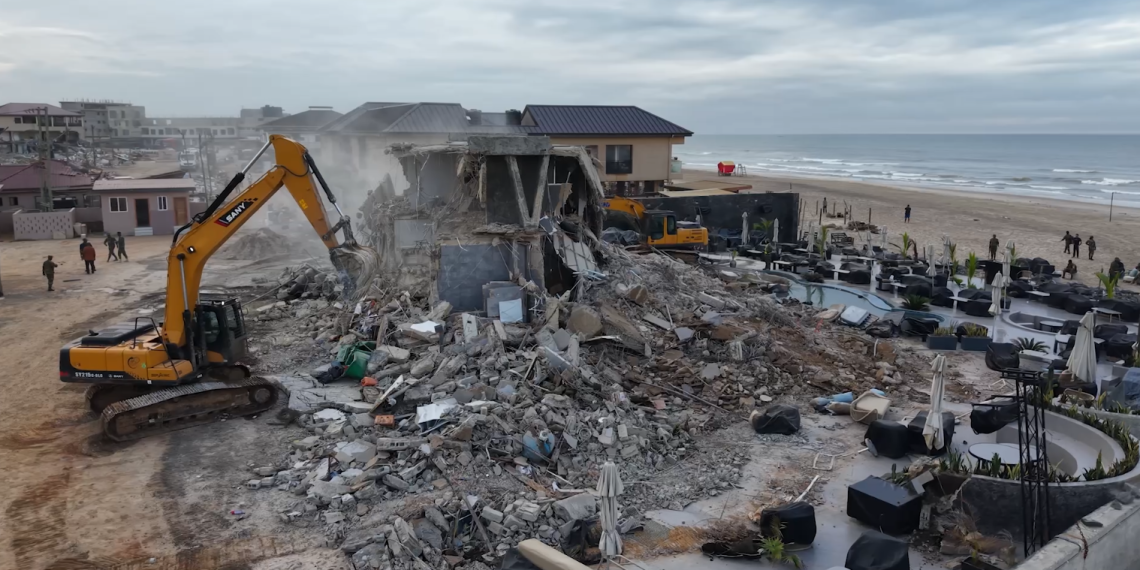
- The demolition of Laboma Beach’s Pink Flamingo Lounge on September 13 is the latest military-led teardown of structures built on waterways and buffer zones across Greater Accra.
- The exercise follows the June 29 floods, which killed residents, displaced thousands, and exposed how routinely permits are issued — or ignored — in protected zones.
- Greater Accra Regional Minister Linda Ocloo has warned that district chief executives who approved building on waterways will be dismissed, but none has yet been named or sanctioned.
- A 2019 pilot to digitize Accra’s permit records — meant to create an auditable database and curb corruption — never scaled beyond AMA and Tema; the process remains largely paper-based today.
- Two June building collapses, at Adenta New Site and Accra New Town, killed three people and injured five — both involved construction without approved plans or permits.
Before dawn on September 13, soldiers from the Ghana Armed Forces’ 48 Engineer Regiment moved into Laboma Beach in the La Dade-Kotopon Municipality.
By midmorning, the Pink Flamingo Lounge — a well-known beachfront nightclub — was rubble, along with several neighboring eateries.
The Post Flood Mitigation Taskforce said the buildings sat inside the protected buffer zone of the Kpeshie Lagoon. The action followed a 21-day eviction notice issued August 7 by the Greater Accra Regional Security Council. Lt. Col. Frank Osei Amponsah, the regiment’s commanding officer, said the task force also intends to dredge the waterway.
The demolition was not isolated.
In July, the same task force cleared structures along the Tesa Dam near East Legon, at New England behind Airport Hills, and at Mayfair Garden Estates, citing illegal retaining walls and years of unchecked development along the water’s edge.
The floods that forced the question
The demolitions trace directly to the floods of June 29, which killed residents, displaced thousands, and destroyed homes across Greater Accra. President John Dramani Mahama subsequently directed that any official found to have approved construction on waterways face sanctions.
Regional Minister Linda Ocloo went further, telling journalists in July that any MMDCE — the chief executive of a district assembly — found to have approved such permits would be dismissed.
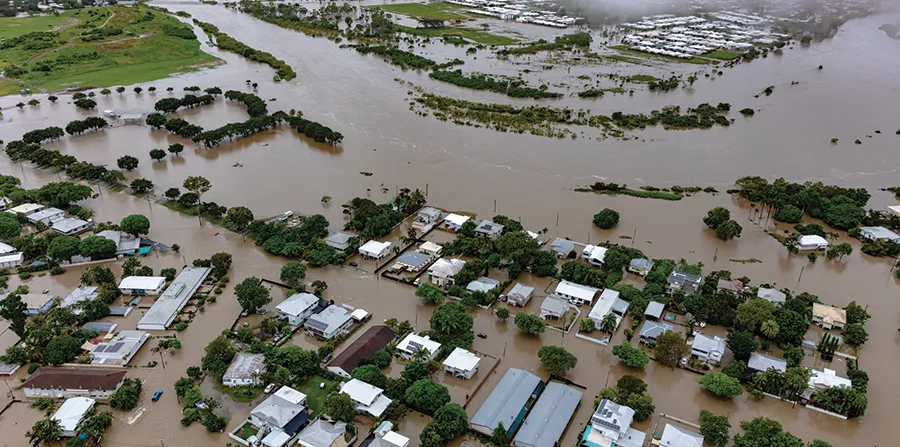
She said she wanted “at least one official” held accountable, and disclosed that some structures earmarked for demolition were occupied by people claiming valid assembly permits.
That claim is the crux of the accountability question. If assemblies genuinely issued permits for construction on waterways, the failure lies not just with builders who skirted the rules but with officials mandated to enforce them.
Two months later, no MMDCE has been publicly named or dismissed.
The digital fix that never arrived
Verifying Ms. Ocloo’s claims — checking who signed off on which permit, and when — depends on records that can be audited. That capability was supposed to exist by now.
In April 2019, Ghana’s government announced a web-based digital permitting system for Accra, funded by the UK’s Department for International Development. The pilot covered AMA and the Tema Metropolitan Assembly, with plans to extend it nationwide.
Officials said it would create an electronic database of every permit record, drawings included, and link AMA’s process to the Lands Commission, Fire Service, Police and EPA — the same agencies whose sign-off makes a permit legally valid. The purpose was explicit: cut the “human-factor” delays and errors that fed corruption, and give assemblies a searchable record of who approved what.
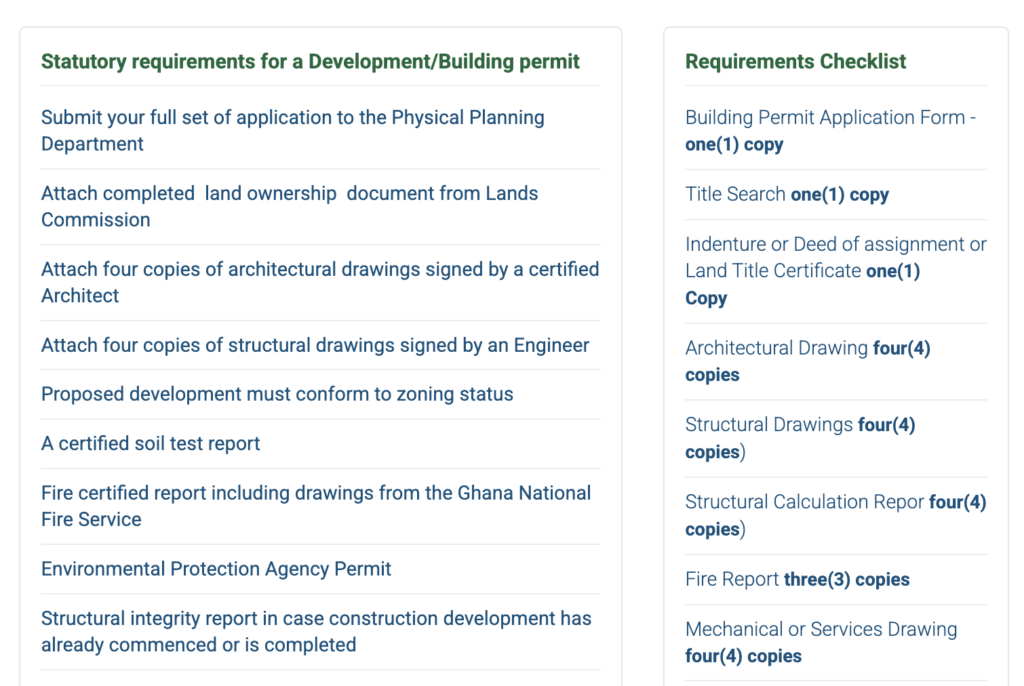
Six years later, that record does not appear to exist. AMA’s own published requirements still describe a manual process: physical forms, four hard copies each of architectural and structural drawings, and in-person committee inspection.
Academic research on Ghana’s building regulatory environment published within the past year describes the system as still “manual” and “time-consuming,” treating electronic permitting as a reform Ghana has yet to adopt.
No public record explains what happened to the pilot, or why it never scaled beyond AMA and Tema.
Ms. Ocloo’s investigation into waterway permits depends on assemblies producing a clear, tamper-resistant record of approvals. A paper-based system, held in individual assembly offices with no central database, is far easier to lose, alter or dispute than the one promised in 2019.
Anyone trying to identify who approved a lagoon-adjacent lounge is working with the same manual infrastructure that has always made accountability hard to pin down.
How permits are supposed to work
Under the National Building Regulations, 1996 (L.I. 1630) and the Ghana Building Code of 2018, anyone building in Accra must secure a development permit from the relevant assembly — AMA within the city proper — with zoning input from the Town and Country Planning Department.
Projects near wetlands or waterways require additional EPA clearance. Permits typically take one to three months and remain valid for five years; building without one is a criminal offense.
Assemblies are legally responsible both for approving developments and for enforcing regulations within their jurisdictions — the same body that grants a permit also polices violations of it.
Analysts point to this dual role, combined with under-resourced inspectorates lacking sufficient inspectors, vehicles and testing equipment, as a structural weakness that leaves site visits irregular and often too thin to catch structural defects.
When enforcement fails, buildings fall
The cost has been measured in lives, not just property. In June, a three-storey building collapsed at Adenta New Site, trapping five people; investigators found no approved plans, no permit, and ignored stop-work orders.
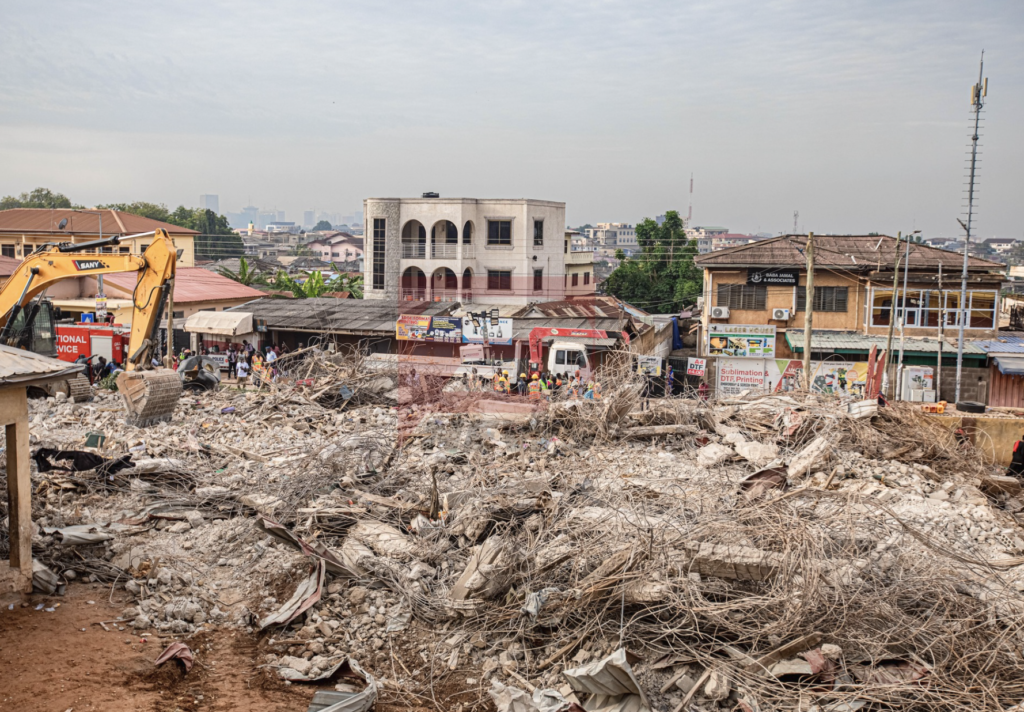
Weeks earlier, a multi-storey collapse at Accra New Town killed three people. Professionals cited in the aftermath identified a familiar pattern: construction without permits, unauthorized alterations, and extra floors added without engineering approval — defects inspections were too thin to catch.
A familiar cycle
A flood or a collapse prompts outrage. A task force issues an ultimatum. Demolitions follow, often carried out by soldiers rather than the assemblies that approved or tolerated the construction in the first place. Attention then moves on — until the next flood.
Residents in Ga Central marched through Santa Maria and Sowutuom this month, petitioning their assembly over flooding that has damaged homes for years — evidence that public pressure for enforcement remains high even as scrutiny of the approving officials lags behind.
What has not yet happened, more than two months after Ms. Ocloo’s warning, is a named case of an official disciplined for approving a permit that should never have been granted.
Nor has any assembly produced the digital audit trail promised in 2019 that would make such a case easier to build.
Until either emerges, the question posed by the rubble at Laboma Beach — who approved this, and why did nothing happen to them — remains unanswered.
Reporting draws on Ghana News Agency, Graphic Online, The Ghana Report, Modern Ghana, Ghana Business News, and academic research on Ghana’s building permitting environment, alongside Ghana’s National Building Regulations (L.I. 1630) and the Ghana Building Code, 2018.
This article was edited with AI and reviewed by human editors