


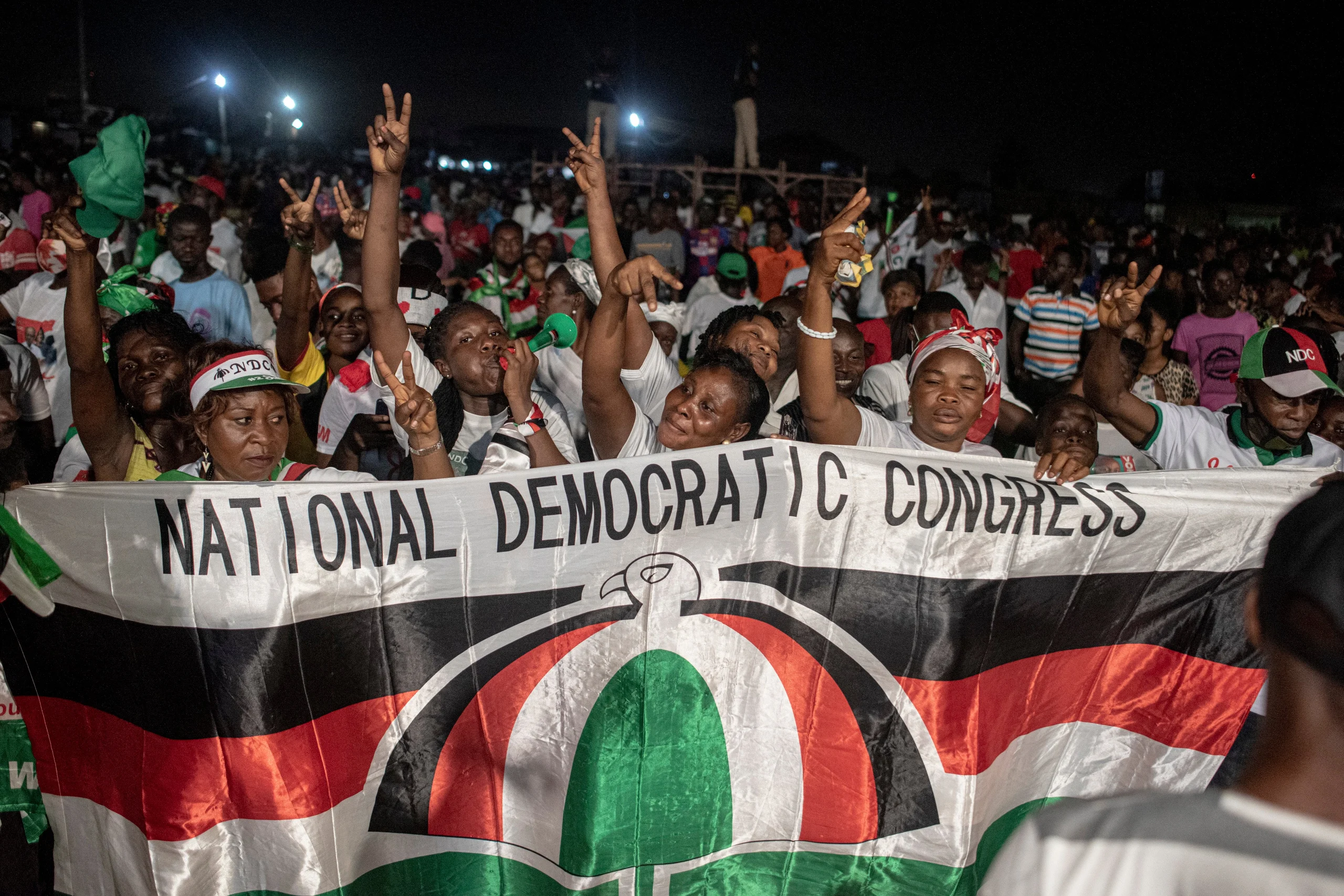
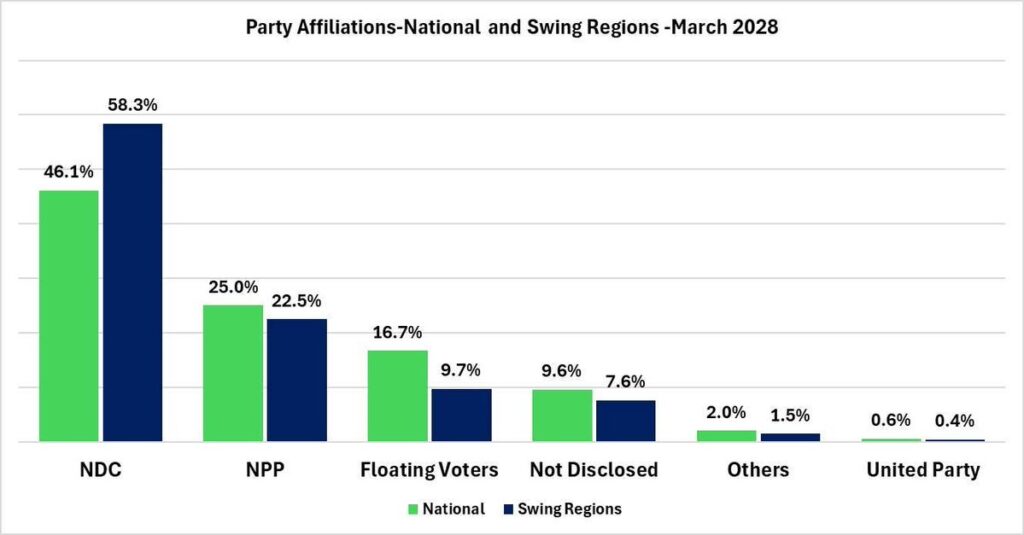
ACCRA, GHANA – Ghana’s National Democratic Congress (NDC) holds a commanding national advantage over the New Patriotic Party (NPP) as Ghana looks toward 2028, with new polling data showing the NDC at 46.1% nationally — nearly double the NPP’s 25% — and performing even stronger in crucial swing regions.
The survey, conducted by Global InfoAnalytics, a local data and polling company, covered all sixteen administrative regions and tracked party affiliation trends since December 2025. The data reveals a broad deepening of NDC support even in areas traditionally considered NPP strongholds.
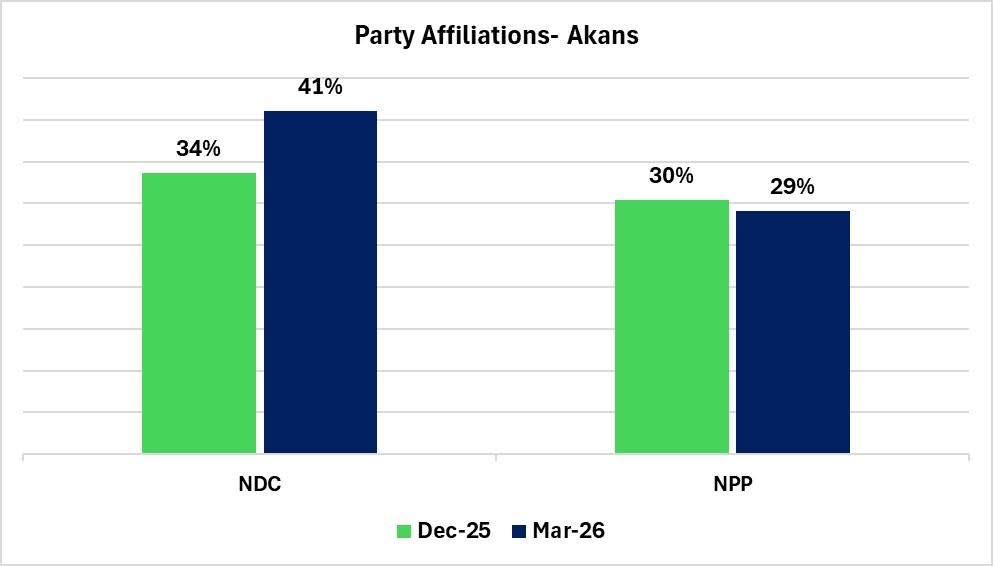
The most striking development is a seven-point surge in NDC affiliation among Akan respondents, from 34% in December 2025 to 41% in March 2026, while the NPP saw a marginal dip from 30% to 29% in the same demographic.
The Akan community has historically leaned toward the NPP — making the NDC’s 12-point gap among this group a significant data point. If the trend holds, it could reshape the calculus for the 2028 general election well before campaign season begins in earnest.
Swing regions tell a sharper story
The polling draws a clear distinction between national averages and swing-region performance. In the battleground areas that typically decide Ghanaian elections, the NDC’s advantage widens considerably.
With 58.3% affiliation in swing regions compared to the NPP’s 22.5%, the gap is a striking 35.8 percentage points.
The floating voter pool, which stood at 16.7% nationally, shrinks to just 9.7% in swing regions — suggesting that undecided voters in the most competitive constituencies are already gravitating toward a side, and the NDC appears to be the primary beneficiary.
Regional picture: NDC dominant across most zones
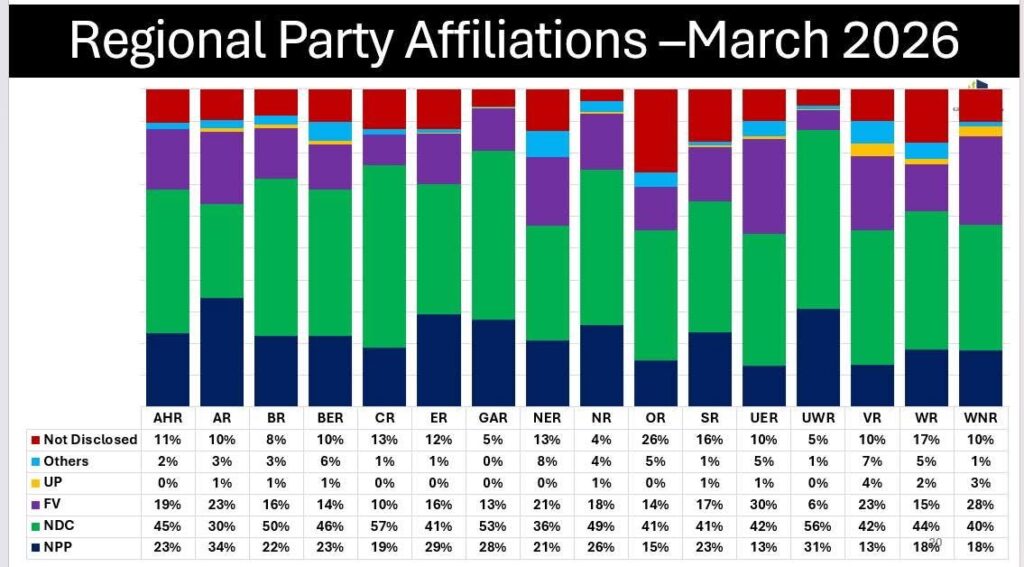
The regional breakdown from the March 2026 data shows the NDC leading in fifteen of sixteen regions surveyed. The Central Region records the highest NDC affiliation at 57%, followed by the Northern Region at 49% and the Upper West Region at 56%.
The NPP’s strongest showings are in the Ashanti Region (34%) and Bono Region (22%) — its traditional belt — but even there, the NDC either matches or exceeds the NPP’s numbers in most adjacent areas.
Notably, the Ashanti Region — long considered the NPP’s bedrock — shows NDC and NPP tied at 34% and 34% respectively in the latest poll, a development that would have been considered improbable only a few electoral cycles ago.
What the numbers mean for 2028
With nearly two years before the next general election, these figures represent affiliation trends rather than vote projections.
However, the consistency of the NDC’s advantage across demographic groups, ethnic communities, and geographic regions suggests the party has built a structural lead that the NPP will need to work hard to erode.
The NPP’s challenge is compounded by the floating voter trajectory. Nationally, 16.7% of respondents identify as floating voters — a pool that both parties will aggressively court.
But the compression of that group in swing regions to 9.7% suggests the window for the NPP to consolidate undecided support in crucial constituencies may already be narrowing.
The minor parties remain marginal, with the “FV” affiliation bloc accounting for 13–23% in several regions but the United Party and other smaller formations struggling to break beyond single digits in most areas.
This article was edited with AI and reviewed by human editors



Follow