


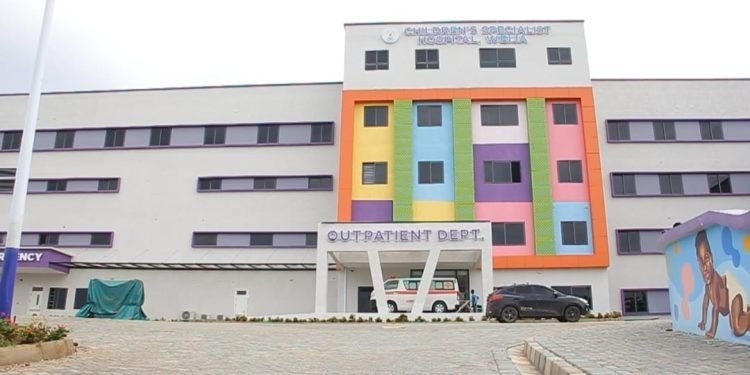
STORY HIGHLIGHTS
- The World Bank formally declared misprocurement on a $3.8 million contract awarded to AWERCO Construction Limited for medical equipment at the Weija-Gbawe Paediatric Hospital, cancelling the funds entirely.
- A World Bank post-procurement review found that key items under the contract were billed at 3 to 11 times their market value, in violation of IDA procurement regulations.
- The 120-bed hospital, completed in early 2025, remains shut despite community protests, as the Ministry of Health and contractor trade blame over who is responsible for the impasse.
- AWERCO has threatened legal action, demanding the Ministry retract statements it says are false and defamatory.
ACCRA — A hospital built to serve Ghana’s most vulnerable patients — sick children — sits fully completed but padlocked. Meanwhile, a paper trail quietly assembled by the World Bank tells a story of medical equipment billed at prices so inflated they would be difficult to explain under any ordinary accounting.
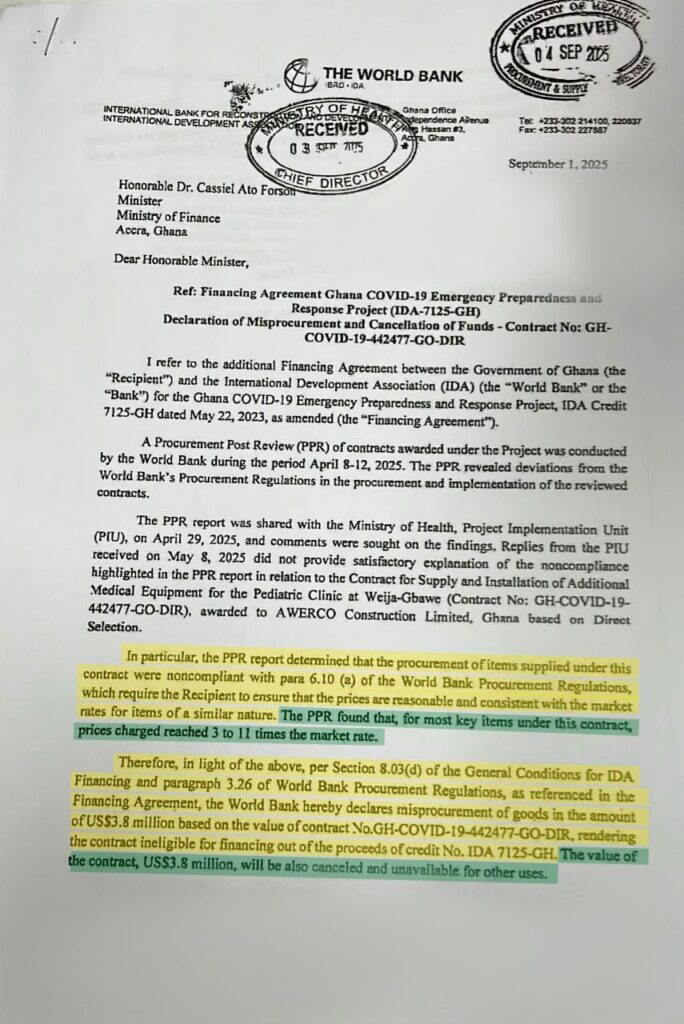
A September 1, 2025 letter from the World Bank’s Ghana Office, addressed to Finance Minister Dr. Cassiel Ato Forson and reviewed by The Labari Journal, formally declared misprocurement on Contract No. GH-COVID-19-442477-GO-DIR — a deal to supply and install additional medical equipment at the Paediatric Clinic in Weija-Gbawe, awarded to AWERCO Construction Limited through direct selection.
The Bank cancelled the full contract value of US$3.8 million, rendering it ineligible for financing under IDA Credit 7125-GH, the Ghana COVID-19 Emergency Preparedness and Response Project.
The Labari Journal emailed the World Bank to confirm the authenticity of the letter and for comments on the cancellation of the remaining funds.
The Bank confirmed authenticity, with Kennedy Fosu, an External Affairs Officer, releasing this statement:
“The Project closed on December 16, 2025, following a 6-month extension to allow for the completion of key activities for which Government had not released IDA spending.
Nevertheless, at project closing, several activities remained incomplete, including at the Weija hospital (the installation of some equipment and the implementation of selected safety measures required by the Bank’s Environmental and Social Framework for health facilities).
Post-closure, the Government may use undisbursed IDA funds under the project to pay outstanding obligations for IDA eligible activities until June 16, 2025.
Government is responsible for providing its own resources to complete the outstanding environmental and social safeguard obligations under the project and to settle any obligations it has incurred for expenditures ineligible for IDA financing.
To fully operationalize the hospital, the Government will need to complete these necessary actions and assign staff to the facility. The World Bank remains engaged to encourage the Government to operationalize and open the facility.“
Prices That Defied the Market
The World Bank’s findings stem from a Procurement Post Review (PPR) conducted between April 8 and 12, 2025 — covering contracts awarded under Ghana’s COVID-19 Emergency Preparedness and Response Project.
The review flagged the AWERCO contract as noncompliant with Paragraph 6.10(a) of the Bank’s Procurement Regulations, which obligates recipients to ensure that contract prices are reasonable and consistent with prevailing market rates.
The PPR’s conclusion was stark: for most key items under the contract, prices charged were between three and eleven times the actual market rate.
The Bank shared its findings with Ghana’s Ministry of Health Project Implementation Unit (PIU) on April 29, 2025, requesting a response.
When replies arrived on May 8, 2025, the Bank found them unsatisfactory — insufficient to explain the scale of the pricing deviations. Under Section 8.03(d) of the General Conditions for IDA Financing and Paragraph 3.26 of the Bank’s Procurement Regulations, the misprocurement declaration followed.
The $3.8 million was cancelled and declared unavailable for any other use under the credit.
A Hospital Held Hostage
The financial fallout has had a direct human cost. The fully furnished 120-bed hospital, completed in early 2025, was expected to serve as a major referral centre for paediatric care, easing congestion at existing health facilities and improving outcomes for critically ill children. It has not opened.
On May 5, 2026, residents staged a protest at the hospital site, demanding its immediate commissioning.
In response, the Ministry of Health issued a public statement acknowledging the standoff.
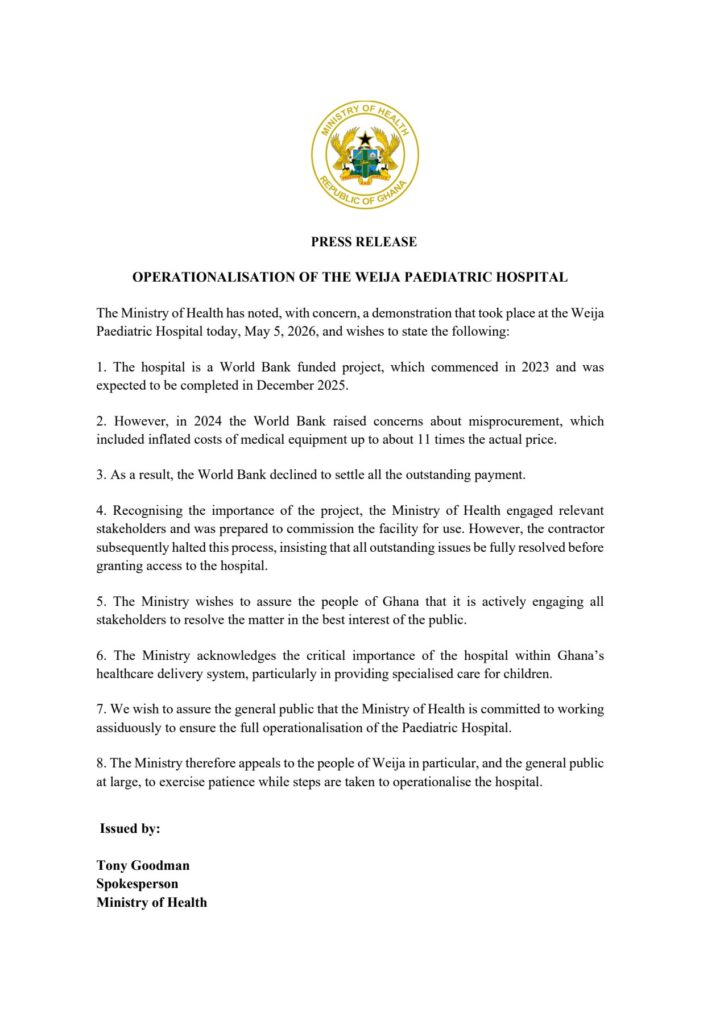
The Ministry confirmed the hospital project commenced in 2023, was initially scheduled for completion in December 2025, and encountered setbacks after the World Bank flagged alleged misprocurement issues.
As a result, the World Bank declined to settle all outstanding payments, and the contractor subsequently halted the commissioning process, insisting that all outstanding issues be fully resolved before granting access to the hospital.
The Contractor Pushes Back
AWERCO Construction Limited has come out and defended itself. In a letter dated May 8, signed by Yaw Acquah, Head of Dispute Resolution at A.E.K. Kodjoe & Associates, solicitors for AWERCO described the misprocurement allegation as “unfounded and without any disclosed factual or evidential basis,” adding that the World Bank’s concerns were never formally communicated to the company.
The contractor also reframed the narrative around the hospital’s closure. AWERCO accused the Ministry of using its press release to divert public attention from the Ministry’s own inaction, saying the company had repeatedly written over the past year requesting payment of outstanding amounts, but those letters had gone unanswered.
The company also disputed suggestions it had halted the commissioning of the facility, clarifying that its correspondence had focused solely on proper handover procedures and the need for critical protective systems — specifically Uninterruptible Power Supply units and Automatic Voltage Regulators.
They warned that their absence could damage sensitive medical equipment and compromise hospital operations.
AWERCO further warned that without the completion of mandatory end-user training — which it says cannot proceed without payment — hospital staff would be unable to safely operate the installed equipment, posing direct risks to future patients.
The company has demanded an immediate retraction of specific paragraphs from the Ministry’s May 5 statement and threatened litigation if the Ministry fails to comply.
A Ministry of Health spokesperson, Tony Goodman, in response, insisted that the government will not retract its claims of alleged procurement irregularities, saying the Ministry’s position is based on facts and will be defended in court if necessary.
Accountability Without Answers
The dispute raises questions that neither the Ministry nor the contractor has yet answered publicly. If the prices for medical equipment were indeed inflated by up to eleven times, who authorised the contract and signed off on the procurement process?
And if AWERCO was never formally informed of the World Bank’s findings, as it claims, why did Ghana’s PIU fail to loop in the contractor when seeking to respond to the Bank’s queries?
Demonstrators in Weija argued that the delay was exacerbating access to paediatric healthcare in the area, placing additional pressure on nearby health facilities.
The World Bank has already acted — cancelling $3.8 million and walking away from the contract.
What remains unresolved is accountability: who inflated those prices, who approved them, and who will answer for a children’s hospital that Ghana paid for but cannot use.
Update: We updated our article to include a statement from the World Bank
This article was edited with AI and reviewed by human editors



Follow