



STORY HIGHLIGHTS
- The Labari Journal estimates 75–85% of daily output from Ghana’s major digital news outlets is reactive or quote-driven, relying on press releases, official statements, and politician speeches
- Deep-dive and investigative journalism remains a small minority of daily output, concentrated in a handful of specialist outlets and occasional big projects
- Economic incentives, ownership structures, and safety risks structurally discourage accountability reporting
- A growing cohort of investigative initiatives offers a corrective — but they remain exceptions in a noisy, volume-driven ecosystem
Open the homepage of any major Ghanaian news outlet on any given morning, and the pattern is immediate: a minister spoke, a police unit seized contraband, a politician warned, a court ruled, an official promised.
The headlines move fast, and the quotes come thick. What is harder to find is the story behind the story — the why, the who-benefits, the systemic failure underneath the event.
Ghanaian media is, by most measures, one of the most vibrant and pluralistic press ecosystems on the African continent. It is also, by the evidence of its own daily output, heavily skewed toward the reactive and the superficial.
A Labari Journal review of content across major digital outlets — Graphic Online, MyJoyOnline, Citi Newsroom, and GhanaWeb — in early March and late May 2026 found that roughly 75 to 85 percent of daily stories are quote-based or event-driven pieces: reports anchored in press releases, police announcements, or ministerial speeches, with limited independent verification or broader contextual framing.
Original investigative or deep-dive journalism — work involving exclusive sourcing, cross-verified documents, fieldwork, or data analysis — constitutes a small minority of what Ghanaians read each day.
A Taxonomy of the Problem
The imbalance is not uniform across outlets, but it is consistent in direction.
Graphic Online, the best-resourced of Ghana’s traditional newspaper brands, leans heavily on official responses: the Prisons Service commenting on a high-profile case, GBC management responding to audit queries, the Electricity Company of Ghana on network upgrades.
Some comparative features — including an analysis of the 2024 and 2026 iterations of the anti-LGBTQ bill — gesture toward deeper reporting.
Still, an estimated 65 to 75 percent of its visible top stories are quote- or official-driven.
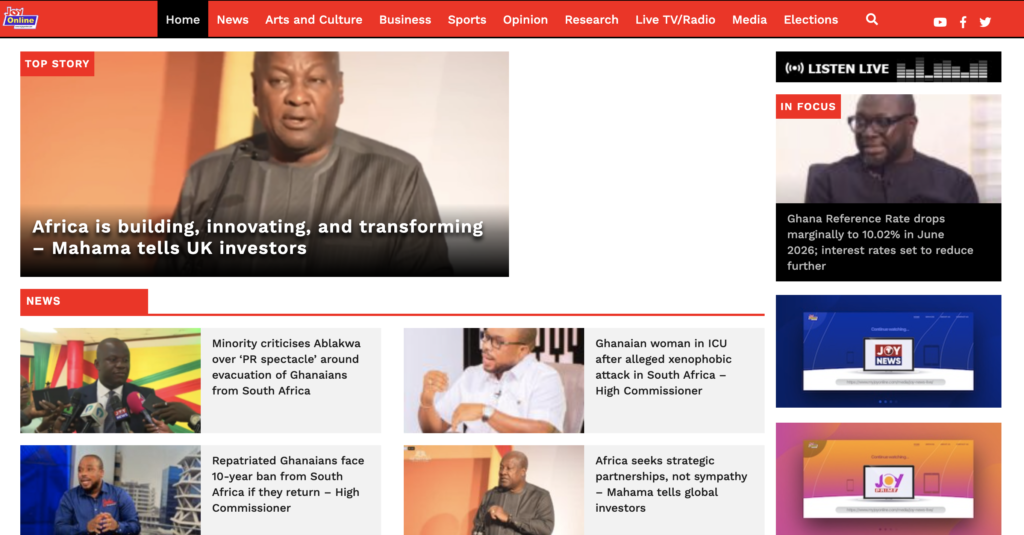
At MyJoyOnline and Citi Newsroom, the ratios are steeper. Somewhere between 70 and 85 percent of their daily output falls into the reactive category — political statements, transport fare debates punctuated by official and dealer quotes, ministerial warnings about audits.
GhanaWeb, functioning primarily as a high-volume aggregator, sits at the extreme end, with an estimated 85 to 95 percent of its content aggregated, syndicated, or reactive.
The pattern seemingly reflects the incentive architecture of the Ghanaian media economy.
Speed Over Depth
Ghana’s digital news economy is advertising and click-driven. Traffic is the currency, and traffic rewards speed.
A press release turned around in twenty minutes serves the algorithm. A three-week investigation into procurement irregularities at a state enterprise does not — at least not reliably or immediately.
The economics punish depth. Deep dives require time, travel, legal exposure, and sometimes physical risk.
Reactive coverage requires a working phone and a reliable contact in a government communications office. When newsrooms are understaffed and underfunded, the rational choice is volume.
Compounding the economic pressure is the ownership structure of much of the Ghanaian press. A significant share of outlets maintain visible or tacit affiliations with political parties or their financiers.
This produces a particular kind of reactive journalism — not neutral stenography, but partisan stenography, in which “he said/she said” coverage is selectively deployed to advance factional narratives.
Safety and the Chilling Effect
The risks facing Ghanaian investigative journalists are not abstract. The ecosystem has produced high-profile cases of harassment, digital attacks, legal injunctions, and unsolved violence against reporters.
Strategic lawsuits against public participation — SLAPP suits — have been deployed against journalists and their outlets with documented effect.
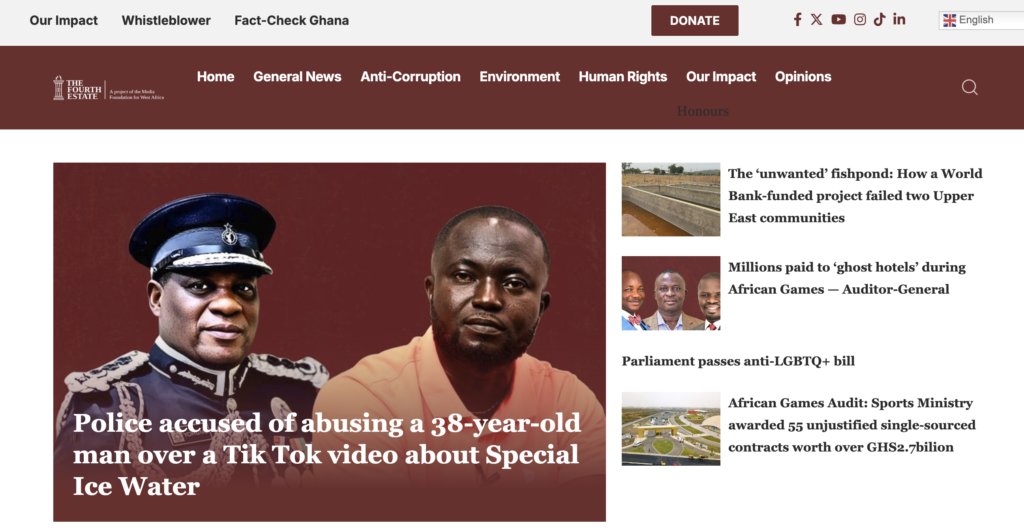
Stanley Nii Blewu, a journalist, published a story in The Fourth Estate, describing how a mining giant threatened to sue him for a story on the lack of water in a mining community.
“It dampened my spirit,” he told The Fourth Estate. “I thought I had done a good story. Everybody commended me. But the company claimed their name had been mentioned in the wrong way.”
These conditions do not prevent investigative reporting, but they price it at a premium that most newsrooms cannot or will not pay.
The journalist who pursues a powerful subject faces exposure that a reporter summarizing a government press conference does not. Rational risk aversion pushes coverage toward the safe and the official.
The practice of “soli” — facilitation payments to journalists from sources seeking coverage — adds a further layer of structural distortion, compromising the arm’s-length relationship between reporter and subject that accountability journalism requires.
Where Accountability Journalism Lives
The picture is not entirely bleak. A small but meaningful cohort of outlets and initiatives produces work that meaningfully departs from the reactive norm.
The Fourth Estate, a project linked to the Media Foundation for West Africa, has built a track record of accountability reporting on governance and public finance.
Ghana Business News, under Emmanuel Dogbevi, produces sustained coverage of corporate and regulatory issues with more analytical depth than most.
Anas Aremeyaw Anas and Tiger Eye PI have delivered undercover investigations with significant institutional impact.
Fellowship programs administered by the MFWA and collaborations with the Global Investigative Journalism Network have seeded capacity in individual journalists, even where institutional infrastructure is thin.
These are genuine bright spots. They are also, relative to the daily volume of Ghanaian media output, exceptions.
What It Costs
The consequences of a media ecosystem dominated by reactive journalism are not merely aesthetic. A press that functions primarily as a conveyor belt for official statements — even a loud, pluralistic, competitive one — has a limited capacity to hold institutions accountable.
Citizens receive volume: a daily torrent of quotes, announcements, and political sparring. What they receive less of is systematic scrutiny of how public resources are allocated, how contracts are awarded, how policy decisions are made, and by whom.
On issues like galamsey, public procurement, economic governance, and infrastructure delivery, the gap between what is reported and what is knowable is significant.
The information exists. The capacity and incentive to surface it, verify it, and present it in ways that serve the public interest remain underdeveloped.
Ghana’s press is free. It is diverse. It is, by regional standards, remarkably active. It is not yet, in its daily practice, adequately watchful.
Fixing that requires more than individual editorial will. It requires a different economic model — one that funds depth — stronger protections for journalists, meaningful enforcement of the Right to Information Act, and institutional investment in the kind of reporting that takes weeks to produce and cannot be measured in clicks.
This article was edited with AI and reviewed by human editors



Follow