


STORY HIGHLIGHTS
- Ghana’s Lands Commission has pursued digital land records for over two decades, with limited nationwide impact
- A $85 million agreement with PDB Ghana Limited, first announced in 2023, remained in legal review as of early 2024 with no confirmed signing
- The World Bank-backed Ghana Digital Acceleration Project stalled in February 2025 after key staff contracts were terminated
- The Enterprise Land Information System (ELIS) remains the backbone of online services, but manual processes still coexist with digital ones
- A new controversy erupted in January 2026 when MP Kwame Asare Obeng (“A-Plus”) launched a private land acquisition app, sparking community backlash and allegations of illegal land appropriation
ACCRA, GHANA – A corporate buyer had been looking to purchase a premium parcel of land in the city of Accra.
To help with their search, they ordered their legal representatives to submit a formal request for a Certified True Copy (CTC) and a consolidated search report through the country’s Lands Commission’s Online Services Portal.
When the official Commission search report came back, it presented an incredibly messy, internally contradictory history.
The search report stated that the parcel was originally Nungua Stool land that had been compulsorily acquired by the Republic of Ghana way back in 1940.
In 2010, the State formally released portions of it back to the Stool. The Stool then legally leased it to a private developer, who subsequently assigned the rights to a real estate firm. This gave the appearance of a clean, traceable chain of title.
However, deeper in the same Lands Commission search report, the record showed that the land was simultaneously affected by active “plotting” and registration records belonging to an entirely different, unrelated company.
A completely separate Land Title Certificate number had been issued to this second company, citing a different grantor (seller) who had never appeared anywhere else in the original chain of custody.
In essence, the Lands Commission’s own official documentation effectively proved that two completely different entities had validly registered, legal claims to the exact same piece of earth.
Because of this discovery, the transaction was immediately halted, saving the buyer millions of Cedis but leaving them without the land.
Many prospective land buyers have faced similar issues when it comes to land acquisition in Ghana. The country’s land administration system can best be described as “archaic” and manual.
Over the last few years, it has tried to fix the problem with digitisation.
But in a country where land disputes are among the most common causes of litigation, and where the World Bank has long flagged weak property administration as a drag on investment, Ghana’s digital land reform story reads less like a march of progress than a cycle of ambitious announcements followed by institutional inertia.
Two Decades of Digitization, Still Incomplete
Ghana’s effort to build a functional digital land information system stretches back more than two decades, embodied in successive platforms — the Ghana Enterprise Land Information System (GELIS) and its successor, the Enterprise Land Information System (ELIS).
Despite measurable progress by the Lands Commission, manual processes continue to coexist alongside digital ones, leaving the system far from the seamless, countrywide infrastructure reformers have long envisioned.
A 2024 peer-reviewed study examining the effectiveness of Accra’s land information system found that while the city’s framework is well-aligned with clear institutional mandates and supportive laws, it remains at the beginning of a comprehensive learning and development curve.
In plain terms: Ghana has the legal scaffolding for a modern land registry. The operational reality still lags far behind.
Data on land ownership, use, and value remain fragmented, and systems enabling automation and reliable access to land information remain inefficient — fuelling persistent problems including double sales of the same parcel, unauthorized alterations to land documents, and entrenched corruption and bribery.
The $85 Million Deal That Has Yet to Move
Central to Ghana’s digitization hopes was a landmark private partnership. In September 2023, the government announced it would sign a contract with PDB Ghana Limited, a wholly-owned Ghanaian land administration company, to inject $85 million into the Lands Commission’s operations over five years.
The project was expected to focus on digitally mapping the entire country, resulting in a National Spatial Data Infrastructure, digital records processing, staff training, and new tools and equipment for the Commission.
By the time the Commission held a media briefing in February 2024, the deal still had not crossed the finish line. The agreement was still being reviewed by stakeholders for submission to the Attorney General’s office, while a value-for-money audit was ongoing, commissioned by the Ministry of Finance.
Officials were careful to manage public expectations about the nature of the arrangement. The Lands Commission’s Executive Secretary, Benjamin Arthur, clarified that PDB Ghana Limited would not be involved in the Commission’s operations — its role was confined to providing investment and technical services support.
That assurance did little to resolve the more pressing question: when would the money actually arrive?
As of the time of writing, no credible public record confirms that the contract has been executed. The Commission’s own 2025 website activity makes no reference to the PDB deal being operational.
The Labari Journal reached out to the Lands Commission and PDB for comment on the deal. We did not hear back at the time of publication.
The World Bank Project in Limbo
Ghana’s troubles with the PDB arrangement are mirrored in its broader digital reform portfolio.
In 2025, there were reports that the Ghana Digital Acceleration Project (GDAP), backed by $200 million from the World Bank and approved by Parliament in May 2023, had been suspended.
The World Bank denied those reports.
But no disbursements have been made since September 2024.
A World Bank implementation report noted that the incoming minister had demonstrated a strong commitment to reviving the project, with staff recruitment underway and a mid-term review planned for the first half of 2026.
For a project meant to anchor Ghana’s entire digital public services transformation — of which land administration is a component — the pause is significant.
A New Government, Familiar Rhetoric
The Mahama administration, which took office after the December 2024 elections, has moved to restate its commitment to the digitization agenda.
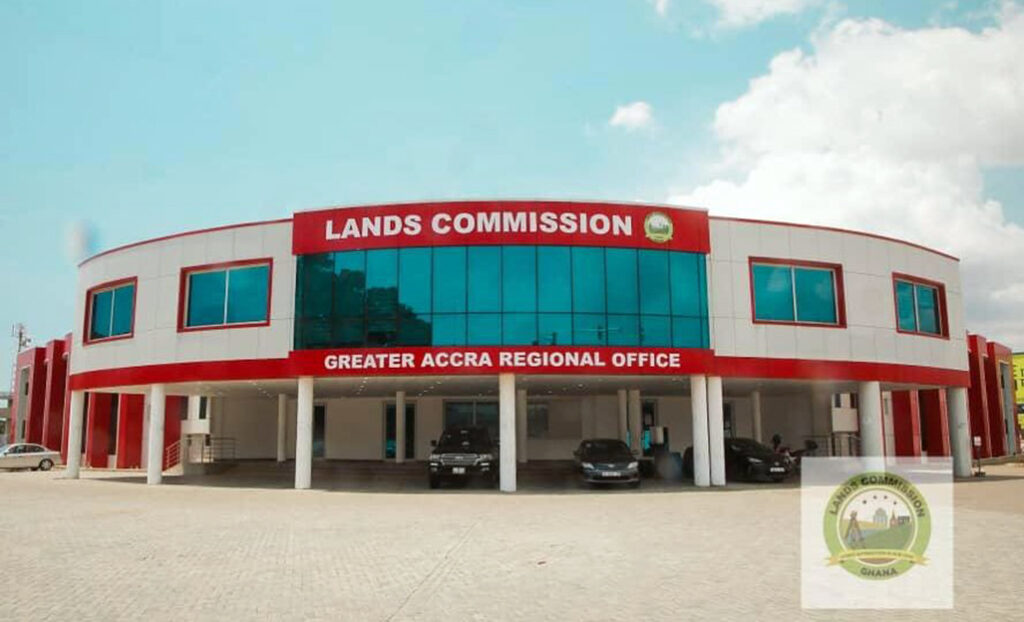
In August 2025, the Minister for Lands and Natural Resources, Emmanuel Armah-Kofi Buah, inaugurated a new Greater Accra Regional Lands Commission Board and declared that the Commission’s ongoing ELIS digitization would eliminate manual inefficiencies and reduce corruption.
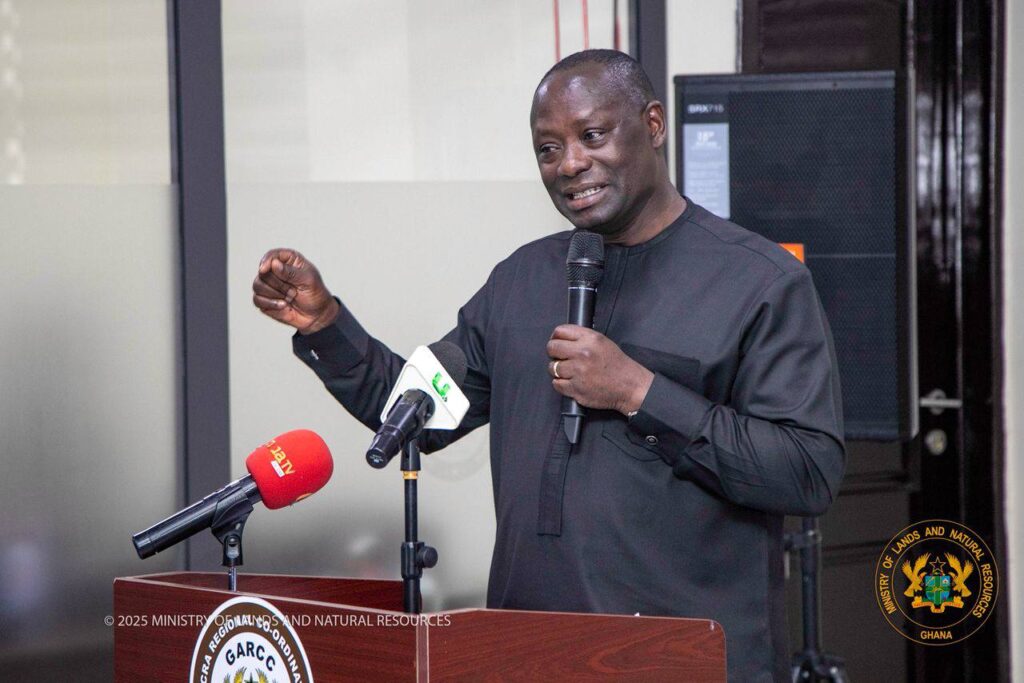
He identified three priorities for the board: accelerating decentralisation of land services, ensuring compliance with allodial title registration under the Land Act, 2020, and strengthening collaboration with the judiciary on dispute resolution.
An earlier address from 2024 by then-Lands Minister Jinapor acknowledged that while ELIS had enabled selected services — including consolidated searches, stamp duty assessment, and plan approvals — to be completed online, full migration from manual operations was still in progress.
That progress, however welcome, remains anchored largely in Accra. Rural regions and peri-urban areas, where land disputes are often most acute, have seen far less of the digital dividend.
A Gomoa Central MP, A Digital Land App, and a Community in Conflict
Against this institutional backdrop, a more disruptive — and controversial — experiment in digital land management surfaced in late 2025.
On October 22, 2025, the Independent MP for Gomoa Central, Kwame Asare Obeng — widely known as A-Plus — unveiled the Digital Land Acquisition and Management Platform (DILAP) as part of the launch of the Gomoa Central Special Economic Zone at the Kempinski Hotel in Accra.
The platform was presented as a transparent digital tool that allows investors to browse available land, make payments, and track projects from acquisition through construction, without intermediaries.
High-profile figures, including the Speaker of Parliament, Alban Bagbin, attended the launch.
Within months, the initiative had triggered a community crisis. A petition dated January 9, 2026, accused A-Plus of using the app as a cover to unlawfully appropriate lands in the Effutu Municipality.
It recalled that during the 2024 election campaign, A-Plus had promised to “reclaim lands” he alleged belonged to Gomoa but were occupied by Effutu communities — a pledge he was accused of pursuing aggressively after winning his seat.
Effutu leaders and residents disputed the platform’s claims, arguing that the lands listed as “litigation-free” were in fact long-contested parcels belonging to the Effutu State.
Community members and traditional leaders questioned the propriety of a sitting MP running a land sales platform, saying his mandate was to legislate, not to develop apps for selling land.
The DILAP controversy illustrates a core tension in Ghana’s land reform story: digital platforms, by themselves, cannot resolve underlying disputes over customary ownership, traditional authority, and competing historical claims.
Without a robust national registry of adjudicated titles, any app is only as reliable as the claims it is built upon.
Still in “Progress”
Ghana’s land digitization ambitions are real, and the institutional framework — from the Land Act, 2020 to the ELIS rollout — provides a genuine foundation.
A new base map survey using blockchain technology to secure and verify land ownership is among the initiatives that have attracted World Bank support.
The challenge has never been a shortage of ideas or announcements. What Ghana’s land sector continues to lack is the connective tissue between aspiration and execution: reliable funding, operationalised contracts, and a records system that extends beyond Accra’s boundaries.
Until the PDB deal is confirmed, the GDAP project is revived, and ELIS reaches the regions where land is most contested, the country’s digital land transformation will remain, as it has for two decades, perpetually in progress.
This article was edited with AI and reviewed by human editors



Follow