Story Highlights
- A coalition of more than 90 civil society organisations has called on President Mahama to publish a detailed roadmap and timeline for constitutional reform
- Nearly six months after the Constitution Review Committee submitted its full report, the document remains unpublished and Cabinet has yet to finalise a government position
- Procedural requirements—including a mandatory six-month Gazette notice and referendum logistics—mean delays now could push reform past the next election cycle
- The platform is requesting meetings with the President, Parliament’s leadership, the Council of State and political party leaders
Accra, Ghana — A broad coalition of Ghanaian civil society organisations has issued an urgent call for the government to lay out, in clear and public terms, how and when it intends to carry forward the constitutional reform process that began under President John Dramani Mahama in early 2025.
They warn that the time available to complete the exercise before electioneering takes over is narrowing by the week.
A Coalition Flexes its Muscle
The Citizens’ Platform on Constitutional Reform (CPCR), a coalition convened by CDD-Ghana, STAR-Ghana Foundation, and Democracy Hub and counting more than ninety civil society organisations, trade unions, and professional bodies among its members, used a Steering Committee meeting on June 8 to demand that the Presidency formally publish a roadmap with timelines for reviewing the 1992 Constitution.
The group’s membership list reads like a roll call of Ghana’s civic infrastructure—from the Trades Union Congress and the Ghana Journalists Association to IMANI Africa, the Ghana Registered Nurses and Midwives Association, and the Office of the National Chief Imam.
The platform announced it will seek direct meetings with President Mahama, the Speaker of Parliament, the Majority and Minority Caucus leaderships, the Chairman of the Council of State, and the leadership of political parties—an unusually wide-ranging engagement push that signals the coalition views the moment as decisive.
From “Beautiful Christmas gift” to Four Months of Silence
The urgency stems from what the coalition frames as a stalling implementation process.
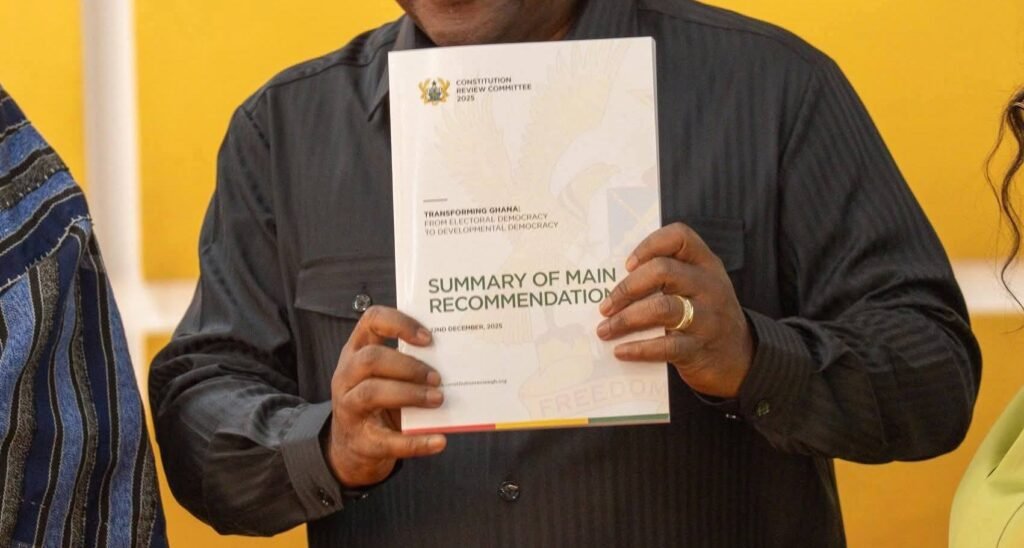
When the eight-member Constitutional Review Committee, chaired by Professor H. Kwasi Prempeh of CDD-Ghana, submitted its final report on December 22, 2025, President Mahama described it as “a beautiful Christmas gift” and directed its publication and release to the public.

The committee had been inaugurated in January 2025 and spent 11 months on its work, ultimately recommending an extension of the presidential and parliamentary term from four to five years, among other sweeping changes.
Mahama said at the time that the document had been handed to the Legal Council and the Attorney-General “to review it, and we will see how to synchronise our views,” and pledged an Implementation Committee would be announced early in 2026.
Six months on, according to the CPCR’s statement, that promised clarity has not materialised. The full report, the platform notes, “is yet to be released or published” despite the President’s public assurance that he did not want it “kept like a nuclear secret.”
Media reports cited by the coalition suggest Cabinet is now considering a draft position paper from the Attorney General’s office and the President’s legal team—covering, among other things, the long-debated proposal to allow direct election of Metropolitan, Municipal and District Chief Executives (MMDCEs).
However, no implementation roadmap, mechanism, or sequencing plan has been made public.
Why the Clock Matters
The CPCR’s statement is notable for grounding its urgency not in rhetoric but in procedure. Ghana’s constitutional amendment process, the platform points out, is structurally slow by design.
Both entrenched and non-entrenched provisions require Gazette publication for a minimum of six months before any bill can be introduced in Parliament.
Entrenched provisions—the more politically sensitive category, which would likely include matters touching the presidential term—must then clear Council of State review and survive a national referendum under Articles 289 to 291.
Non-entrenched provisions require Council of State review and a parliamentary supermajority.
Layered onto Ghana’s electoral calendar, the coalition argues, this means the realistic window to gazette, debate, refer, and pass amendments before the next general election campaign dominates the national agenda is shrinking with every month the government delays a formal position.
The platform’s blunt assessment: “preparatory work must move faster immediately.”
What the Coalition wants Published
The CPCR laid out a specific checklist of disclosures it says the government owes the public:
- release of the full CRC report;
- a published roadmap with concrete timelines and milestones;
- clarity on the mandate, composition, and inauguration of the implementation mechanism Mahama promised;
- an explanation of how the government’s position on the committee’s recommendations will be communicated and opened to public scrutiny;
- a legislative and referendum calendar consistent with constitutional requirements; and
- a framework for sustained civic education and citizen participation.
Beyond demands on government, the platform also extended an offer to political parties—proposing a cross-party compact that would commit parties to agreed timelines, constructive engagement on the substance of amendment bills, and a code of conduct for any eventual referendum campaign that prioritises national interest over partisan advantage.
Given that the CRC’s proposals touch on term extensions, the role of the Attorney General, and the politically charged question of electing district assembly heads, the coalition’s bid to lock in cross-party buy-in early appears aimed at insulating the process from the kind of polarisation that has derailed past reform attempts.
A Chairman Caught in the Crossfire
The CPCR’s intervention also lands against a backdrop of growing political sensitivity around the CRC’s work.
Former NDC Deputy General Secretary Koku Anyidoho publicly admonished Professor Prempeh in late December to stop giving media interviews about the committee’s findings, warning that continued engagements made the chairman “sound like a very partisan politician” and arguing the government’s white paper should “speak for itself.”
Prempeh, for his part, has defended the committee’s approach by noting that Ghana’s recent constitutional experience—including two election petitions, a presidential death in office, and a hung Parliament—made it impossible to simply recycle earlier reform proposals.
That tension between a technical body eager to see its work implemented and a political leadership wary of the optics of fast-tracked, far-reaching constitutional change may help explain the gap the CPCR is now seeking to close.
Whether the Cabinet’s position paper, once finalised, translates into the kind of roadmap the coalition is demanding—or simply produces a narrower set of amendment bills focused on MMDCE elections while the broader CRC agenda quietly stalls—will be an early test of how seriously the Mahama administration intends to follow through on its December commitments.
This article was edited with AI and reviewed by human editors