
Story Highlights
- Ghana’s ride-hailing sector serves roughly 10 million users, but none of its major platforms — Uber, Bolt, Yango, or local entrants — offer wheelchair-accessible vehicle options for the country’s 2.1 million persons with disabilities.
- Despite a Persons with Disability Act that has been on the books since 2006 and explicitly guarantees equal transportation rights, enforcement remains largely discretionary, with no sector-specific regulations holding digital transport platforms accountable
- Advocates say closing the gap requires action on three fronts: targeted government regulation, driver training and incentives, and app design audits against international accessibility standards.
ACCRA, GHANA — The app loads in under five seconds. A car icon slowly moves on the map. A driver is two minutes away.
For the roughly ten million Ghanaians who now use ride-hailing platforms at least occasionally, this has become a normal sequence — an everyday transaction as mundane as buying mobile credit on a phone.
But for persons with disabilities (PWDs), especially wheelchair users, the apps might as well be a menu at a restaurant with no ramp.
Across all the popular ride-hailing apps in Ghana, including Uber, Bolt, and Yango, none have an option to select accessibility vehicles for their needs.
With the non-existence of these options, PWDs are being excluded from access to an on-demand service, which could vastly improve their experience in cities.
Growth of Ride-Hailing Platforms
Ghana’s ride-hailing sector is, by almost any measure, a success story. Since Uber arrived in 2016, the space has expanded rapidly.
Today, Bolt, Yango, Shaxi, and a clutch of smaller local entrants compete vigorously for riders across major cities, including Accra, Kumasi, and Takoradi.
Ghana’s ride-hailing penetration rate stands at 42% — among the highest on the continent, surpassing Nigeria and trailing only South Africa and Zambia, according to a 2024 survey by the research firm Sagaci covering 28 African countries.

Market projections put the sector’s value at roughly $95 million for the year, and analysts expect it to continue growing as smartphone penetration deepens and urban populations concentrate.
Competition has meaningfully driven down prices. A survey of 156 Accra residents found that 71.4% considered the services within financial reach of middle-class users, and 22.2 percent believed even lower-income earners could afford occasional rides.
But these apps, unfortunately, don’t do enough to capture a particular segment of users who have often been sidelined in Ghanaian society.
Two Million People Waiting
According to the 2021 Population and Housing Census, 2.1 million Ghanaians, representing about 8% of the population, live with a form of disability.
Mobility sits at the center of nearly every other dimension of their lives in Ghana. These include access to employment, health care, education, and social participation.
Ride-hailing, in theory, should be a liberating technology for this population.
It should remove the need to navigate Ghana’s chaotic trotro stations, reduce dependence on informal taxis where negotiation and physical transfer can be difficult, and offer the promise of a ride that arrives at your door.
In practice, none of Ghana’s major platforms offer wheelchair-accessible vehicle (WAV) options. These options are available in other markets, including the United States, the United Kingdom, and Australia.
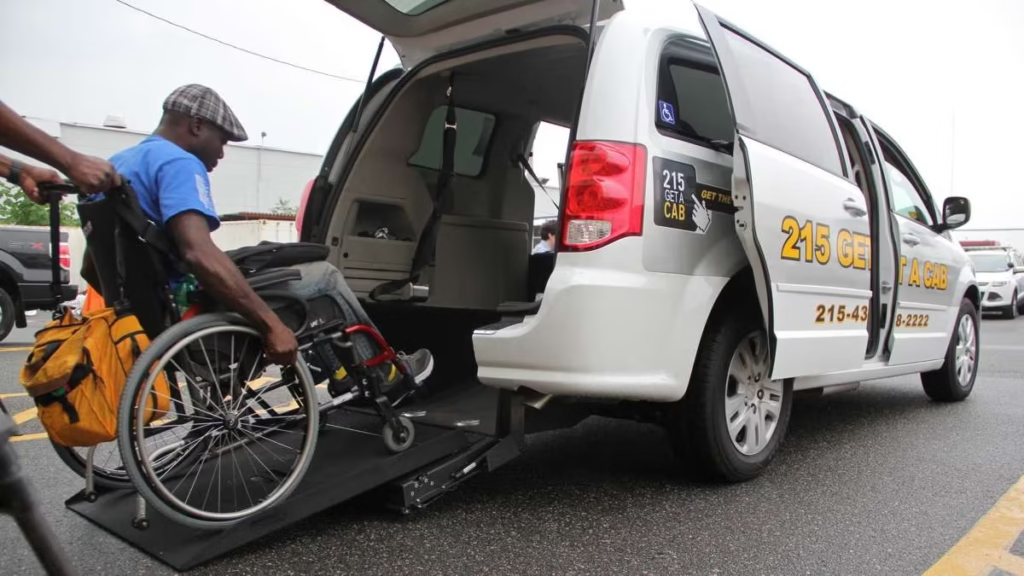
The vehicles on the platform in Ghana are usually standard sedans and hatchbacks. The app is designed with one body type in mind.
“Most of the vehicles available are regular cars not equipped to accommodate wheelchairs,” a 2023 analysis by the Ghanaian technology publication Tech Labari noted.
“This means wheelchair users have to either transfer to a seat — which can be difficult and uncomfortable — or rely on other modes of transportation, which may not be as reliable or safe.“
The Labari Journal reached out via email to ride-hailing platforms, including Bolt, Uber, Yango, and Shaxi, for comment on any timelines in securing WAV vehicles for persons with disabilities.
Sandra Suzanne Buyole, the Regional PR Manager for Africa, sent us a statement:
“In multiple markets, we already offer dedicated categories for riders who require wheelchair-accessible vehicles, with informed drivers and appropriately equipped cars. We continue to assess opportunities to expand these solutions further.
The availability of adapted categories depends on local fleet supply, regulatory frameworks, and operational readiness. Where such services are not yet available, we are actively exploring sustainable ways to introduce them in collaboration with local partners.”
We did not hear back from Uber, Yango, and Shaxi at the time of publication.
A Law With No Teeth
Ghana is not without a legal framework. The Persons with Disability Act, 2006 (Act 715), was passed after sustained advocacy by the Ghana Federation of the Disabled and civil society groups.
The Act guarantees persons with disabilities equal rights in a range of domains — including, explicitly, transportation. Sections 23 through 30 of the Act outline inclusive transportation planning obligations. The law has been on the books for nearly two decades.
The enforcement record is difficult to celebrate. A 10-year moratorium written into the legislation required all public buildings to be made disability-accessible by 2016.
Eleven years after that deadline, researchers and disability advocates continue to document widespread non-compliance.
In a research study, only 2 of 5 surveyed monumental public buildings in Accra fully comply with international accessibility guidelines.
Ghana’s Building Regulations 2022 (LI 2465) incorporated the Ghana Accessibility Standard and assigned MMDAs the responsibility of scrutinizing permit applications for compliance.
However, enforcement remains largely discretionary.
Act 715 does not specify what is expected of construction professionals or the penalty for non-compliance, meaning architects and contractors face no real accountability.
The National Council on Persons with Disabilities, tasked with overseeing implementation, was inaugurated in 2013, seven years after the Act was passed.
The failure to enforce existing law has a direct bearing on the ride-hailing question. There are no sector-specific standards requiring digital transportation platforms to provide accessible services.
Ride-hailing companies operating in Ghana face no regulatory pressure to add wheelchair-accessible vehicle categories and no meaningful penalties for non-provision.
Local Platforms, Same Blind Spots
The arrival of GoRide — launched in October 2024 by then-Vice President Mahamudu Bawumia as a locally developed ride-hailing application — was greeted with enthusiasm by segments of the transport sector.
The platform, built in partnership with the Ghana Private Road Transport Union (GPRTU), was designed to offer drivers better commission terms.
Accessibility for disabled users did not feature prominently in the launch messaging.
Shaxi, another local entrant positioning itself as a patriotic alternative to foreign platforms, similarly does not advertise wheelchair-accessible options.
The homegrown platforms, despite their different ownership structures and rhetorical emphasis on serving Ghanaian communities, have inherited the same blind spots as their multinational competitors.

What Change Would Require
Disability advocates and transport researchers suggest that closing the accessibility gap would require action on multiple fronts simultaneously.
Regulation is the most direct lever: a government directive requiring ride-hailing platforms operating in Ghana to phase in accessible vehicle categories and meet app accessibility standards would shift the incentive structure immediately.
Ghana’s existing disability law provides the statutory foundation; what is needed is an implementation of regulations specific to digital transport platforms.
Driver training and incentive structures are a second dimension.
Studies of WAV programs in other countries have found that driver reluctance is as significant a barrier as vehicle availability. Platforms that have made progress have done so by pairing vehicle incentives with driver education programs and building robust feedback mechanisms that surface service denials.
Persons with disabilities will continue to be left out of the ride-hailing conversations if the current enforcement of the Disability Act continues to be ignored.