


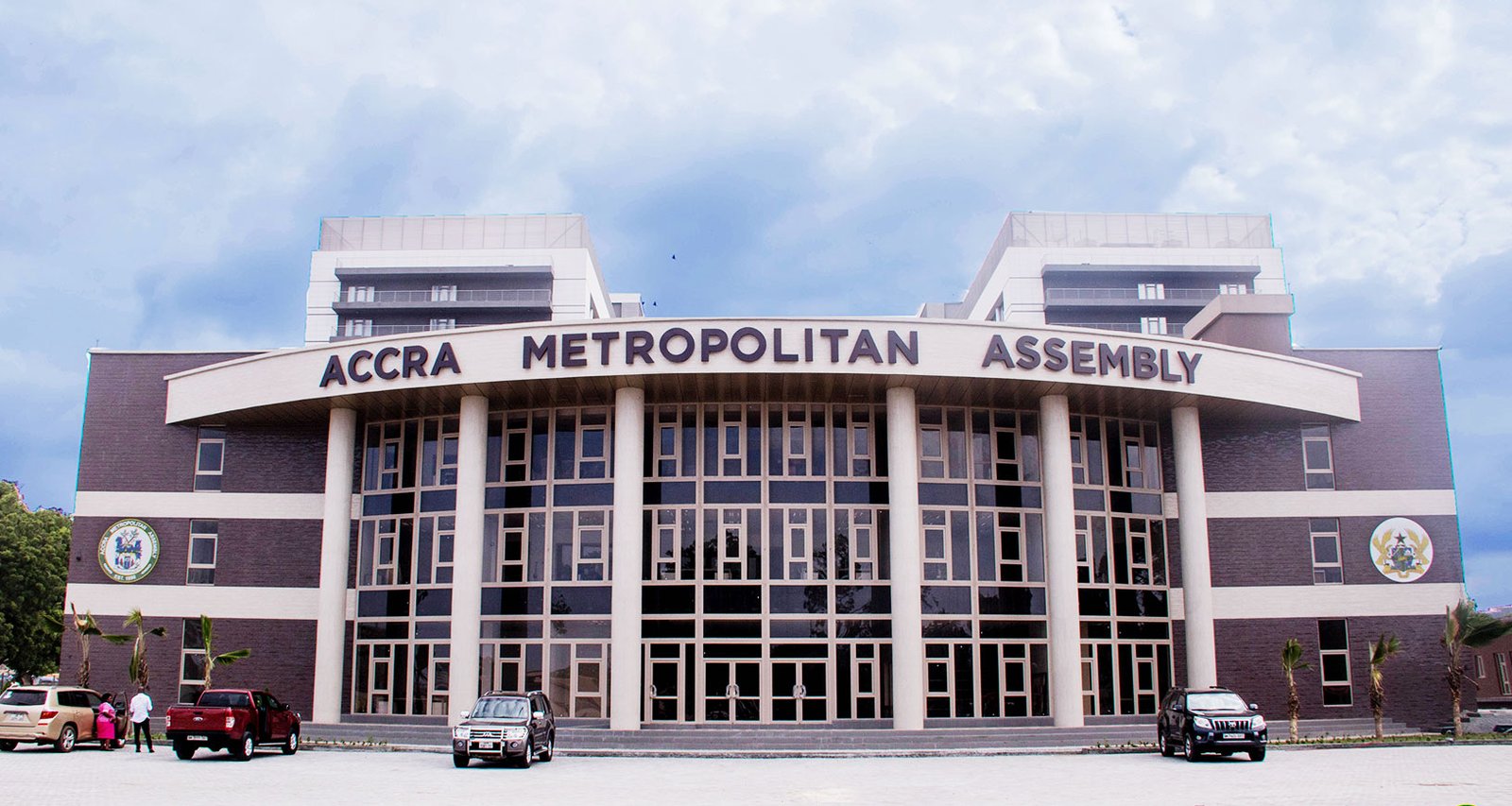
Story Highlights
- Parliament’s Public Accounts Committee (PAC) has twice in recent cycles flagged the Accra Metropolitan Assembly (AMA) for unaccounted revenue collected by its own staff, most recently over sums exceeding GH¢150,000
- A separate Auditor-General finding tied to the 2022 accounts showed 31 revenue collectors across eight assemblies, including AMA, failed to account for GH¢391,531.87 from market and lorry park tickets
- The Assembly’s internal auditor was given a formal ultimatum by PAC Chairman James Klutse-Avedzi, who accused the office of negligence
- AMA’s history of contested evictions stretches from the 2002 Old Fadama removal fight to a 2018 court injunction over Agbogbloshie demolitions to an ongoing 2025-2026 dispute at Makola Market, where traders have filed injunctions against a redevelopment project
Accra’s local government has a persistent paper problem, and it shows up in the same place every year: the gap between what collectors take from the city’s markets, lorry parks and trading floors, and what actually lands in the Assembly’s account.
In May 2024, Public Committee Account (PAC) members reviewing the Auditor-General’s report on the Accra Metropolitan Assembly’s (AMA) 2022 accounts learned that 31 revenue collectors across eight assemblies had collected GH¢391,531.87 from market tickets and lorry park tickets without accounting for it.
Committee Chairman James Klutse-Avedzi directed the Assembly’s Finance Officer to produce the relevant files within two weeks, telling AMA management to be more diligent and to resolve outstanding anomalies before its next appearance before the committee.
A closely related but separately reported finding centered on a smaller, AMA-specific figure. The Auditor-General’s report disclosed that six revenue collectors at the AMA had failed to deposit GH¢151,000 into the Assembly’s account.
While AMA officials said part of the money had been recovered, GH¢110,000 remained unaccounted for.
PAC gave the Assembly’s internal auditor, Ridwan Kokroko, a two-week deadline to produce documentation or refund the balance himself. Mr. Avedzi attributed the gap to the internal auditor’s negligence, telling him directly, “You are not doing your work as an auditor.”
Whether these are two separate incidents or overlapping references to the same underlying set of defaulting collectors is not fully clear from the public record — a distinction PAC’s own file, once produced, should settle.
What is clear is that both threads point to the same structural weakness: cash collected at street level in Accra’s markets and lorry parks is not reliably reaching the Assembly’s central accounts, and the internal audit function meant to catch that gap has itself been publicly faulted by Parliament.
A Pattern That Predates This PAC Cycle
Other assemblies — Ga South, La Dadekotopon, Ningo Prampram, Ablekuma Central, Krowor and Tema Metro — were cited in the same PAC session for rent arrears, unearned salary and payroll irregularities.
This would suggest the weaknesses are not unique to AMA but are shared across Greater Accra’s local government structures.
That context matters for readers assessing whether AMA’s record reflects a management failure specific to the Assembly or a wider gap in Ghana’s district-level financial controls — something the Auditor-General’s annual reports on district assemblies address at a national scale each year.
Nationally, irregularities flagged in the Auditor-General’s public accounts reports have not been trending downward.
The Auditor-General’s report on Ministries, Departments and Agencies has documented recurring patterns of undeposited revenue, unretired imprests and procurement breaches across the public sector, with district assemblies as a category audited each year separately under the Public Financial Management Act, 2016 (Act 921) and its accompanying regulations.
AMA’s citations sit inside that larger, recurring national audit cycle rather than as an isolated event.
Evictions: From Old Fadama to Makola
Revenue accountability is only one thread in AMA’s contested record. The Assembly’s approach to slum clearance, decongestion and market redevelopment has generated a parallel history of legal challenges and public confrontation stretching back more than two decades.
The starkest early example is Old Fadama. Residents were served an eviction notice by AMA on 28 May 2002 as part of the Korle Lagoon Ecological Restoration Project.
Civil society groups, including COHRE, argued the notice gave too little warning, that residents had not been meaningfully consulted, and that no adequate resettlement had been offered. Residents sought a High Court injunction to block the eviction, but the court rejected the application on 24 July 2002 and authorized AMA to proceed.
Old Fadama has remained a recurring flashpoint in the years since.

A decade later, a 2012 demolition exercise at Circle Railway, near the VIP bus terminal, escalated when shop owners and squatters whose structures were pulled down accused then-AMA boss Alfred Okoe Vanderpuije of moving ahead of the notice period he had personally announced.
Police used tear gas and pepper spray to disperse the crowd after a resident set fire to one of the structures, and arrests followed.
In 2018, the Assembly’s demolition powers were checked directly by the courts. The Accra High Court’s Land Division placed an interim injunction on AMA and the Attorney-General’s office over an intended demolition at Agbogbloshie, a property claimant filed suit, arguing the land was in dispute.
The court restrained AMA from proceeding for ten days pending further hearing.
June 3 Flood Lawsuit
In June 2018, 69 victims of a flood incident instituted a class action suit against GOIL, the National Petroleum Authority, the Accra Metropolitan Assembly, and the station manager, seeking accountability, compensation, and justice.
The victims are seeking GH¢40 million in compensation from the NPA and GOIL PLC for the loss of 150 lives, injuries, and destruction of property.
The conduct of the Accra Metropolitan Assembly — the body most directly responsible for enforcing the planning and safety regulations that failed on June 3, 2015 — drew sharp criticism.

The lawyer for the victims alleged that the AMA had at times failed to appear before the court, attracting sanctions in the process.
It is a pattern that speaks to the broader institutional posture that victims and their advocates say has characterised the response to this disaster from the start: delay, disengagement, and deflection.
The case was scheduled for June 15, 2026, with an AMA witness expected to testify and be cross-examined. All parties are to submit written addresses to the court for final determination.
The Current Fight: Makola’s Material Stores
That same tension — between the Assembly’s stated redevelopment goals and traders’ resistance to displacement — is playing out again now. AMA is redeveloping the one-storey material stores at 31st December Makola Market into a four-storey complex, part of Mayor Allotey’s broader “Red Line” decongestion policy.
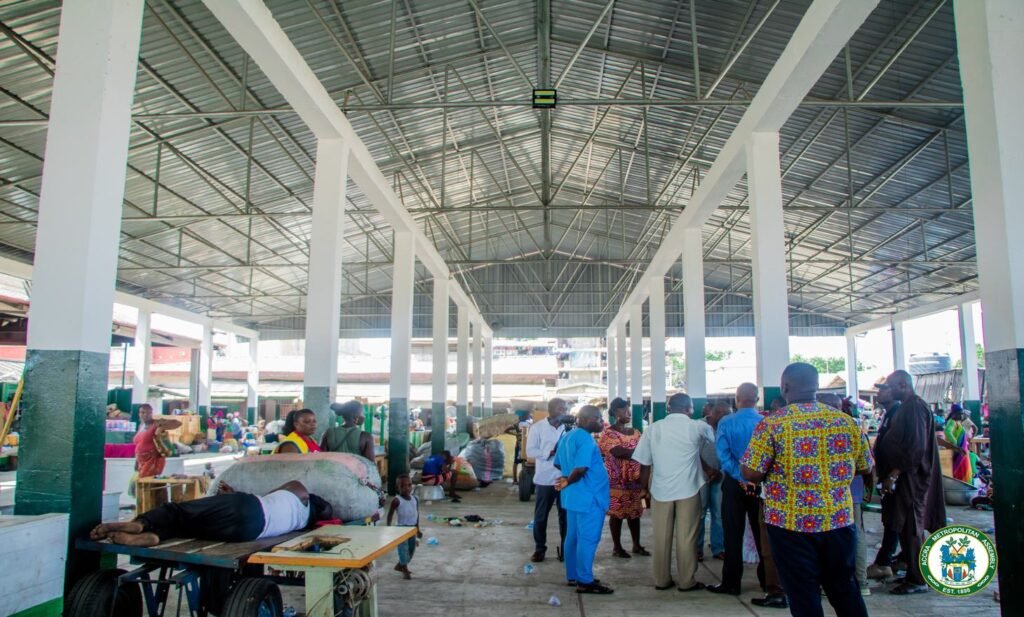
The Assembly insists the process has been consultative: the General Assembly approved the redevelopment on 30 June 2025, and affected traders were formally briefed at a stakeholder meeting on 27 August 2025; the relocation deadline was extended from October 2025 to January 12, 2026, after appeals.
But the dispute has already reached the courts. An Assembly member confirmed that some traders filed injunction applications to halt the project, with an earlier application dismissed by the High Court for non-compliance with the Local Governance Act, while another application has since been filed.
Officials acknowledged that some resistance comes from third-party occupants who fear losing access once original allottees are reinstated after the rebuild.
Why the Pattern Matters
Taken individually, an unaccounted revenue query or a contested eviction might be dismissed as routine friction in a fast-growing capital.
Taken together, across two decades and multiple mayoral administrations — Vanderpuije, and now Allotey — the record shows the same two fault lines recurring: money collected in markets and lorry parks that consistently fails to reach the Assembly’s books, and redevelopment or decongestion drives that repeatedly end up before a judge.
Neither PAC’s file on the missing GH¢110,000 nor the outstanding Makola injunction has yet been publicly resolved. Both are worth tracking as they move through Parliament and the courts in the months ahead.
This article was edited with AI and reviewed by human editors



Follow